


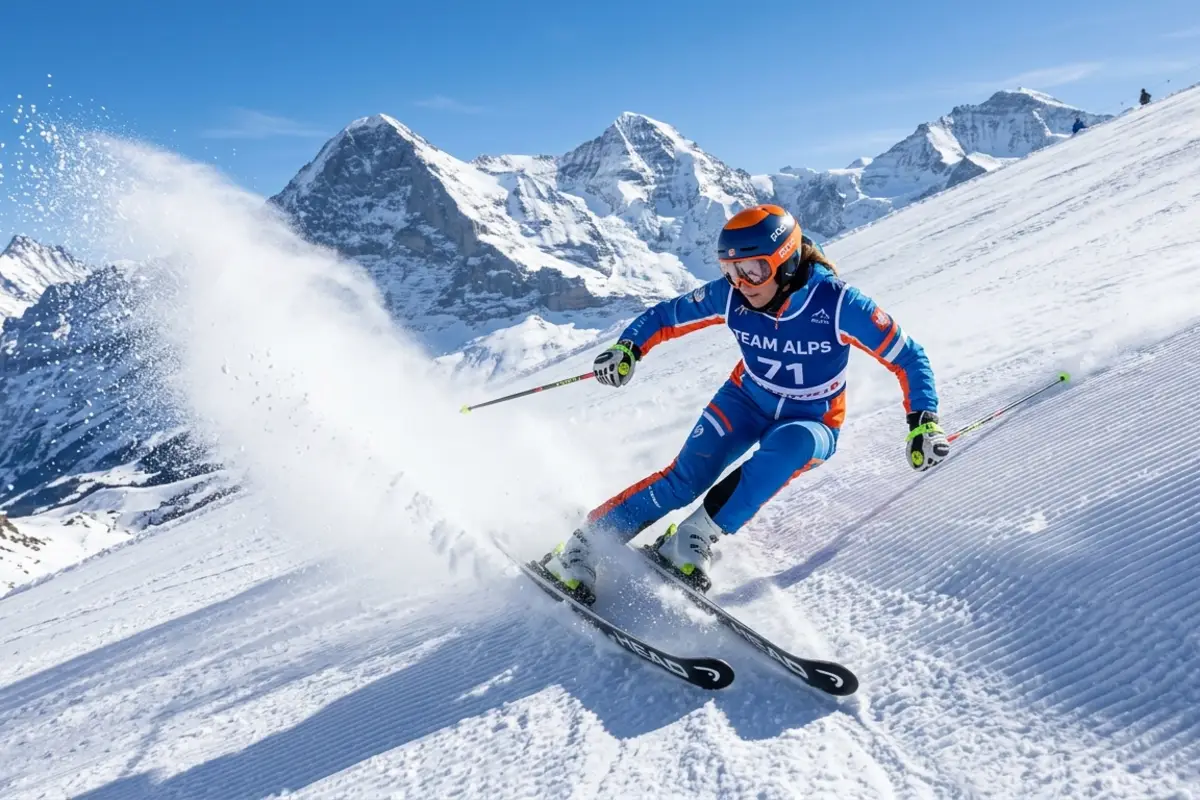
There’s a unique feeling that comes with standing at the top of a steep, black-diamond run. Below you, the slope falls away, a pristine canvas of white that is both intimidating and inviting. For many skiers, this moment is a mix of excitement and apprehension.
The key to transforming that apprehension into pure exhilaration lies in one specific skill: the controlled, rhythmic, and dynamic short turn. Here in Saas-Fee, with access to some of the most spectacular high-alpine terrain in the world, developing this ability opens up a new dimension of skiing. It’s the difference between surviving a steep pitch and truly skiing it with style and confidence.
Many skiers can handle groomed blue or red runs with ease, but when the gradient increases, their technique often changes. They lean back, their turns become wider and more defensive, and speed control becomes a battle against gravity rather than a partnership with it.
The goal is to replace these survival tactics with proactive, precise movements. This requires a deep understanding of body mechanics, edge control, and timing. It’s not about magic; it’s about building a solid technical foundation through targeted practice.
The exercises we will go over are designed to isolate the specific movements required for high-performance turns on challenging terrain, allowing you to build muscle memory and confidence one turn at a time.
This guide is built from years of experience coaching skiers on the demanding slopes surrounding our valley. We see common patterns and challenges every day. The most frequent issue is a misunderstanding of how to generate edge grip and pressure early in the turn.
Skiers often wait too long to commit, resulting in a skid that accelerates them when they least want it. By focusing on specific drills, we can retrain these instincts and develop the assertive, fluid technique that makes steep terrain so rewarding.
Content
Deconstructing the mechanics of a high-performance short turn
Before we get into specific exercises, it’s important to understand the components of an effective short turn on a steep slope. Unlike the long, carving arcs you might make on a wide-open groomer, these turns are compact, quick, and focused on managing speed.
The goal is to keep the skis pointing across the fall line for as much of the turn as possible, rather than down it. This requires a precise blend of balance, edge angle, and pressure control, all executed in a rapid, continuous rhythm.
The role of the lower body: Separation and angulation
The engine of a dynamic short turn is the lower body. Your legs and feet are responsible for steering the skis, setting the edges, and absorbing pressure. To do this effectively, they need to be able to move independently from your upper body. This concept is called “separation.”
Think of your upper body as a stable platform, facing downhill, while your legs rotate beneath you to guide the skis from edge to edge. This separation allows for quicker edge changes and better balance.
Angulation is the other critical piece of the puzzle. This refers to the angles you create with your body—specifically at the ankles, knees, and hips—to get the skis on a high edge angle. On steep terrain, you need a significant edge angle to grip the firm snow.
This is achieved by tipping the skis onto their edges and then driving your center of mass inside the turn, creating a strong, stable platform. Many skiers mistakenly try to create this angle by leaning their whole body into the hill, which compromises balance. True angulation comes from flexing the joints and moving the hips laterally over the skis.
Upper body discipline: A quiet frame for dynamic legs
While the legs are doing the work, the upper body’s job is to remain calm and stable. A common mistake is to rotate the shoulders and torso into the turn along with the skis. This throws you off balance and makes it difficult to initiate the next turn smoothly. Your upper body should remain generally oriented down the fall line. This provides a stable core from which your legs can pivot.
Your pole plant is an integral part of this upper-body discipline. It’s not just for pushing off. A well-timed pole plant acts as a trigger for the new turn. It helps you establish rhythm, maintain your forward stance, and subtly unweight the skis just enough to release the old edges and engage the new ones.
The plant should be a light, precise tap in the snow, initiated by the wrist and forearm, not a heavy stab with the whole arm. It should occur just before you want to start the new turn, setting the tempo for the quick, rhythmic movements to follow.
Pressure control and timing: The feel of the snow
The final element is managing the pressure you apply to your skis throughout the turn. On steep, often firm snow, you can’t just slam the skis on edge. The pressure needs to be applied progressively. As you start the turn, the pressure is light.
As you move through the arc and across the fall line, you gradually increase pressure on the outside ski to maximize edge grip. This is where you control your speed. Then, as you prepare for the next turn, you release that pressure to allow the skis to flatten and change edges smoothly.
This whole sequence—edge release, rotation, edge engagement, pressure build-up, and pressure release—happens in a fraction of a second. Developing the timing and feel for this cycle is what separates good skiers from great ones.
It’s a continuous flow of energy from one turn to the next, creating a “corridor” of controlled speed down the mountain. The drills that follow are designed to break down this complex sequence into manageable parts.
Progressive drills for building steep-slope confidence
The best way to develop the skills for steep terrain is not to throw yourself down the steepest run you can find. It’s to build the component skills on more moderate terrain where you can focus on technique without fear.
Find a well-groomed blue or easy red run with a consistent pitch. This is your training ground. The goal here is perfect practice. Once you can execute these drills with precision and consistency, you can gradually take them to more challenging slopes.
Foundational drills on moderate terrain
These initial exercises are about isolating specific body movements and building muscle memory. Don’t rush them. Focus on the quality of each turn and the sensations you feel through your boots and skis.
- Falling leaf: Start by standing across the fall line. Without turning, practice sideslipping straight down the hill. Then, gently apply pressure to your downhill ski’s front binding to move forward and to the rear binding to move backward. This drill teaches you to feel and control the edge. It’s the foundation of speed management. You are learning to feather the edge to either grip or slip, which is a critical skill when you find yourself in a tight spot.
- Garlands: This is the next step up from the falling leaf. Start traversing across the slope. Initiate a turn as if you are going to turn downhill, but only complete the top half of the turn. Bring your skis back to a traverse in the same direction. Link a series of these “half-turns” together. This exercise forces you to focus on the turn initiation phase—the most important part of a turn on steep terrain. It develops the feeling of engaging the new downhill ski early and confidently.
- Pole plant rhythm drill: On a gentle slope, ski a series of short, rounded turns, focusing exclusively on your pole plant timing. Say “plant, turn, plant, turn” out loud. The pole plant should happen just as you are finishing one turn and beginning the next. This drill builds the metronome-like rhythm that is essential for linking quick turns together. A consistent rhythm prevents you from getting late and losing control.
Transitioning to steeper pitches
Once you feel solid with the foundational drills, it’s time to find a steeper, but still well-groomed, slope. The pitch on the Morenia or certain sections below Längfluh can be perfect for this. The increased gradient will amplify any technical flaws, so your focus must be on maintaining the same correct movements you practiced on easier terrain.
- Pivot slips: This is one of the most valuable short-turn drills for steep slopes. From a stationary position across the fall line, quickly pivot your skis 180 degrees using your legs, keeping your upper body still and facing downhill. You should end up stationary, facing the other direction. The goal is to make the pivot quick and balanced, without any skidding up or down the hill. This drill directly trains lower body separation and the powerful, rotational leg movements needed to snap the skis around in a tight space.
- Corridor turns: Imagine two parallel lines running down the fall line, about 5-6 meters apart. Your challenge is to make all of your turns within this imaginary corridor. This forces you to make complete, rounded turns that finish across the fall line, which is the primary way to control speed on steeps. If you find yourself drifting outside the corridor, it means your turns are not finished and you are picking up too much speed by pointing your skis downhill for too long.
- Uphill ski focus turns: During a traverse, lift your downhill ski completely off the snow and balance on your uphill ski. Now, try to initiate a turn onto the new edge while balancing on that single ski. This is an advanced drill that highlights the importance of balancing on the outside ski of the turn. On steep slopes, your weight must be committed to the downhill (outside) ski to achieve maximum grip. This exercise makes it impossible to cheat by leaning on your inside ski.
As you practice, remember that feedback is vital. If possible, have a friend watch you or even film you. Are you keeping your hands forward? Is your upper body quiet? Are your turns round? Self-analysis, combined with professional coaching, is the fastest way to progress.
At Bespoke Snowsport, we use video analysis extensively in our private lessons to give clients clear, visual feedback they can immediately apply.
Integrating skills and adapting to real-world conditions
Drills are performed in a controlled environment, but the mountain is anything but. Once you’ve built a solid technical base, the next step is to learn how to adapt these skills to variable snow conditions, unexpected bumps, and changing light.
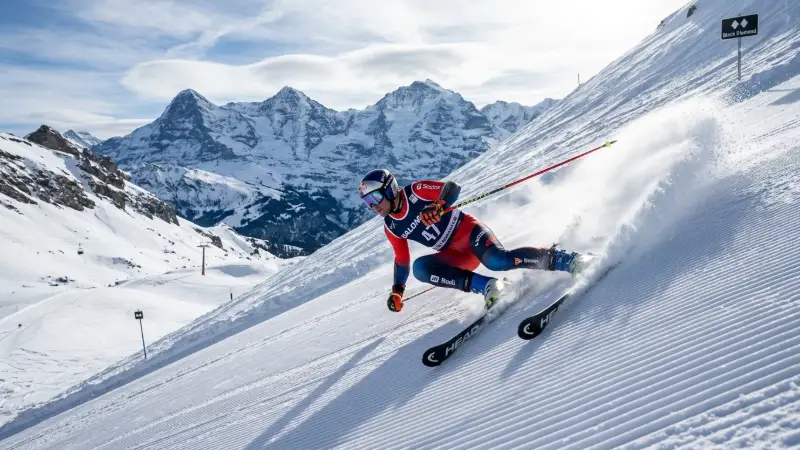
This is where the true art of skiing comes into play, blending technical precision with mountain awareness. The terrain in Saas-Fee is a perfect laboratory for this, offering everything from wind-blown powder to firm, chalky snow, often on the same run.
From drills to free-skiing: Blending the movements
The transition from conscious drilling to intuitive free-skiing can be challenging. The key is to start by “blending.” Begin a run by performing a few deliberate, technically-focused turns, perhaps using the “corridor” mental image.
Then, try to maintain that same feeling and rhythm as you ski more naturally. Don’t try to think about every single body part on every turn. Instead, focus on one key thought or feeling per run. For example, “keep my hands forward” or “feel the pressure on my outside ski.”
This approach helps to transfer the new movement patterns from your conscious brain to your subconscious muscle memory. It’s a process of building trust in your new technique.
You’ll know it’s working when you reach the bottom of a challenging pitch and realize you weren’t fighting the mountain; you were dancing with it. The rhythm becomes automatic, and your mind is free to focus on reading the terrain ahead.
Tactical adjustments for ice, crud, and bumps
Steep slopes rarely offer perfect corduroy. You will encounter ice, crud, and moguls, and your technique must adapt. Here’s how the skills you’ve built apply:
- Ice: On icy patches, your movements need to be more subtle and precise. Over-rotating or banking too hard will cause the edges to break free. Focus on progressive edging—gently rolling the skis onto their edges rather than slamming them down. Maintain a lower, more athletic stance to absorb vibrations and keep your center of mass close to the snow.
- Crud/variable snow: In chopped-up or heavy snow, a more powerful and active leg rotation is needed to drive the skis through the variable resistance. You must be constantly working to keep the skis on your intended path. A strong, stable core and a forward stance are critical to avoid being thrown into the back seat.
- Moguls: Steep, bumpy runs are the ultimate test of short-turn proficiency. The principles are the same, but the timing is compressed. You must absorb the bump with your legs by flexing at the ankles, knees, and hips, and then extend into the trough to start the next turn. Your pole plant on the top of the mogul becomes your anchor point. This requires incredible leg strength, agility, and a precise, unwavering rhythm.
The table below compares the focus points for different conditions, showing how the core technique is adapted rather than changed completely.
| Condition | Primary technical focus | Common mistake to avoid |
|---|---|---|
| Hardpack / Groomed | Precise edge angle and rhythm. Focus on carving a clean arc across the fall line. | Skidding turns by rotating too much and not using the ski’s sidecut. |
| Ice | Subtle, progressive pressure control. Maintain balance over the outside ski without sudden movements. | Leaning into the hill for a false sense of security, which flattens the skis and reduces grip. |
| Crud / Heavy Snow | Active and powerful leg steering. A forward, aggressive stance to drive through the snow. | Becoming passive and letting the snow dictate the turn shape, leading to being thrown unbalanced. |
| Moguls | Absorption and extension of the legs. Constant upper body orientation down the fall line. | Getting stiff and letting the bumps launch you into the air, losing snow contact and control. |
Common pitfalls and how to overcome them
Even with the right drills, skiers often encounter mental and physical barriers when learning to master steep terrain. Recognizing these common pitfalls is the first step toward overcoming them. It’s about being honest with your skiing and understanding that progress is rarely a straight line. There will be frustrating days, but perseverance, combined with smart practice, will always win out.
The mental game: Overcoming fear and hesitation
Fear is the single greatest obstacle. When you’re scared, your body tenses up, you lean back, and you look at your ski tips—all of which are counterproductive. The “back seat” is a defensive posture that feels safe but actually gives you less control. To overcome this, you must build trust in your equipment and your technique.
Start by choosing terrain that is challenging but not terrifying. Success breeds confidence. Celebrate small victories, like linking four good turns on a pitch that used to intimidate you. Visualization is another powerful tool.
Before you drop in, stand at the top and visualize yourself skiing the run with perfect, fluid technique. See the line you want to take. This mental rehearsal prepares your body for what it needs to do.
Finally, remember to breathe. Holding your breath causes tension. A calm, rhythmic breath can help calm your nerves and keep your body loose and responsive.
Physical conditioning: The foundation of powerful skiing
Skiing steep terrain dynamically is physically demanding. It requires a strong core, powerful legs, and good endurance. If your body isn’t up to the task, your technique will break down, no matter how much you practice. A lack of fitness is often the root cause of getting stuck in the back seat late in the day.
An off-season fitness program focused on skiing-specific strength and agility can make a world of difference. Key exercises include:
- Core strength: Planks, Russian twists, and leg raises build the stability needed to keep your upper body quiet.
- Leg power: Squats, lunges, and box jumps develop the power needed for dynamic turns and absorbing terrain.
- Balance and agility: Single-leg balancing exercises and ladder drills improve your coordination and ability to make quick adjustments on the snow.
Arriving for your ski trip in good physical condition improves your performance and significantly reduces your risk of injury. You’ll be able to ski longer, stronger, and more confidently.
Recognizing the “performance plateau”
Many skiers reach a certain level and then stop improving. They can ski most of the mountain, but they do so with the same ingrained, inefficient habits. This is the performance plateau. Breaking through it requires a conscious effort to change those habits.
This is where targeted practice and expert feedback are invaluable. The short turn drills for steep slopes we’ve discussed are designed specifically to address the technical flaws that keep intermediate skiers from becoming advanced.
Breaking a plateau often feels like taking a step backward before you can move forward. The new movements will feel awkward at first. You might even ski “worse” for a little while as you retrain your body.
This is a normal and necessary part of the process. Stick with it. The payoff is a breakthrough in your skiing that will open up the entire mountain and transform your experience.
The journey to mastering steep slopes is a rewarding one. It challenges you both physically and mentally, pushing you to refine your technique and build a deeper connection with the mountain. The skills you develop will not only allow you to ski the iconic black runs of Saas-Fee with confidence but will also improve your skiing on all types of terrain. It’s about replacing survival with performance and fear with flow.
If you’re ready to elevate your skiing and unlock the full potential of this incredible alpine playground, our team is here to guide you every step of the way. We invite you to request any of our ski services, whether it be a private or group lesson, and start your journey toward true mastery of the mountain.