


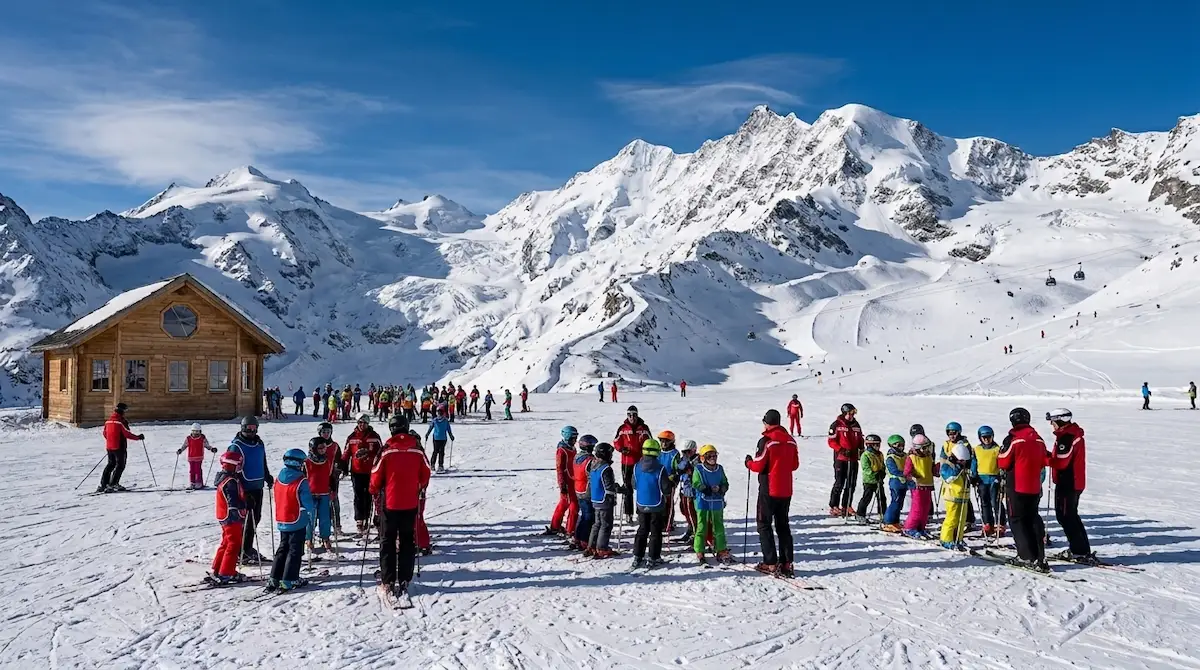
Arriving in a world-class resort like Saas-Fee is an exhilarating experience. The crisp mountain air, the stunning 4,000-meter peaks surrounding the village, and the promise of pristine slopes create a unique sense of anticipation. However, the first day of a ski lesson can also bring a touch of logistical anxiety. Knowing exactly where to go, what to expect, and how to prepare is the key to transforming that anxiety into pure excitement.
This comprehensive guide is designed to demystify the process, ensuring your ski experience starts smoothly, efficiently, and with complete confidence. We will cover the primary locations where instructors and students connect, what each area offers, and how to best prepare for a day of transformative learning on the snow.
The layout of Saas-Fee is both charming and practical, but for a first-time visitor, it can seem complex. The village itself is car-free, which adds to its serene atmosphere but also means that understanding the lift system and pedestrian flow is crucial. Most instructional activities are centered around a few key hubs, each strategically located to provide access to terrain suitable for different ability levels.
From the gentle nursery slopes in the village to the high-alpine glaciers accessed by state-of-the-art cable cars, your meeting point is more than just a location; it is the gateway to your personalized skiing adventure. By understanding these locations, you are already taking the first step toward a successful and enjoyable lesson.
Content
Understanding the main ski areas and their meeting points
Saas-Fee’s ski area is vast and varied, served by a network of lifts that ascend from the village edge to the glacier at 3,500 meters. For ski lessons, instructors select meeting points based on convenience, accessibility, and, most importantly, the type of terrain needed to achieve your specific goals.
Whether you are putting on skis for the very first time or looking to refine your carving on steep red runs, there is a designated spot perfectly suited for the start of your session. Familiarizing yourself with these key areas will make your first morning seamless and allow you to focus on what truly matters: skiing.
The Alpin Express and Felskinn: The heart of the action
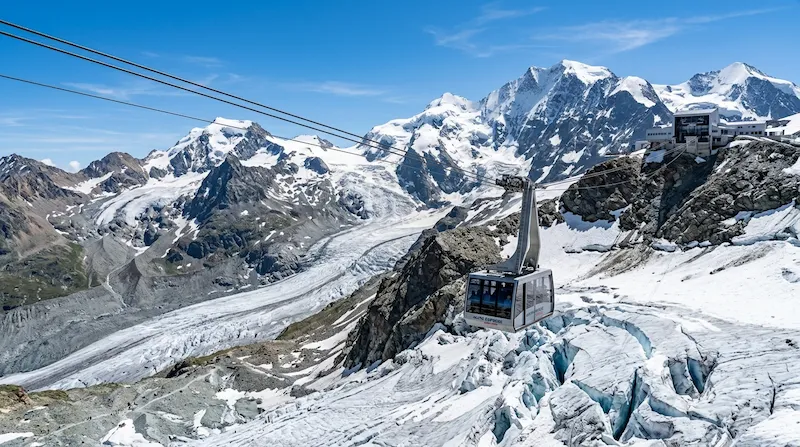
The base station for the Alpin Express gondola and the Felskinn cable car is arguably the most central and bustling hub in Saas-Fee. Located at the southern end of the village, this area is a primary meeting point for intermediate to advanced skiers. Its strategic importance comes from the direct access it provides to the majority of the ski resort.
From here, you can reach the glacier, the Morenia area, and a wide network of blue and red pistes that are perfect for building confidence and developing technical skills. For many of our clients, this is the default starting point for a day of exploration and high-performance coaching.
When you are scheduled to meet here, you will typically find your instructor near the main ticket office or just before the turnstiles for the Alpin Express. This area is often busy, especially between 9:00 AM and 10:00 AM, so arriving a few minutes early is always a wise decision. The proximity to rental shops, cafes, and the main ski pass office makes it a convenient spot to get organized before heading up the mountain.
The terrain accessed from here is ideal for those who are already comfortable on skis and are looking to work on skills like dynamic turning, short turns, and handling variable snow conditions. The long, cruising runs back down to the Morenia station or Spielboden are fantastic for mileage and repetitive, focused practice.
The village lifts: Perfect for first-timers and children
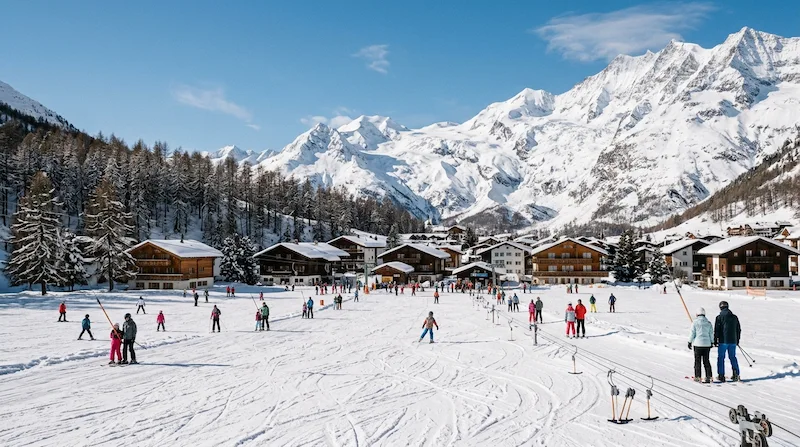
For those new to the sport or for our youngest skiers, the journey begins in a much gentler environment. The village nursery slopes, served by the Kalbermatten and Anfänger (Beginner) lifts, are located on the flat, sunny plateau at the entrance to Saas-Fee. This area is specifically designed for learning.
The slopes are wide, have a very gentle gradient, and are separated from the main ski traffic, creating a safe and encouraging atmosphere. This is the quintessential starting point for anyone who has never clicked into a pair of skis before. The magic carpets and simple button lifts are easy to use and help build confidence from the very first slide.
Meeting points here are usually at the base of the main T-bar lift or near the small hut that serves the area. The environment is much calmer than the main Alpin Express station, which is ideal for families and nervous beginners. Our instructors use this controlled space to introduce the fundamentals: sliding, stopping in a wedge, and making first turns.
Because it is located right in the village, it is easily accessible on foot from most accommodations, and parents can often watch their children’s progress from a nearby cafe. It is a self-contained ecosystem for learning, providing the perfect foundation before progressing to higher altitudes.
Plattjen and Längfluh: For intermediate and advanced skiers

On the eastern side of the valley, the Plattjen and Längfluh lifts offer a different kind of experience and serve as alternative meeting points, often for skiers looking to explore specific types of terrain. The Plattjen gondola accesses a mix of challenging red runs and some fantastic, often quieter, off-piste opportunities.
Meeting at the base of the Plattjen lift is a great choice for strong intermediate skiers who want to work on steeper slopes without the crowds often found in the central ski area. The runs here are long and sustained, providing an excellent canvas for refining carving technique and building stamina.
The Längfluh gondola, accessible via a short ski from the Spielboden station, takes you to the base of the Fee Glacier. This area is a spectacular high-alpine environment and is a meeting point for advanced skiers focused on glacier travel, crevasse awareness, or simply enjoying the breathtaking scenery. The runs from Längfluh are wide and sweeping, offering a unique feeling of skiing in a truly wild and impressive landscape.
Meeting at the top of the Spielboden gondola to then ski down to the Längfluh lift is a common plan for a full-day lesson aimed at exploring the entire resort. These meeting points are less common for first-time lessons but are fantastic options for returning clients or those with specific developmental goals.
Preparing for your first day with a ski instructor
The success of a ski lesson begins long before you click into your bindings. Proper preparation ensures that your time on the mountain is maximized for learning and enjoyment, not spent dealing with logistical issues. From having the right gear to knowing the resort’s schedule, a little planning goes a long way.
This is particularly true in a high-altitude environment like Saas-Fee, where weather conditions can change rapidly and energy levels can be affected by the altitude. Taking care of the details beforehand allows you to arrive at your meeting point relaxed, focused, and ready to ski.
What to bring: Your essential checklist
Dressing appropriately is the single most important factor for comfort and performance on the mountain. The key is layering. Your clothing system should be adaptable to a range of temperatures, from cold, shady mornings to sunny, warm afternoons.
Start with a moisture-wicking base layer (merino wool or synthetic; avoid cotton), add a fleece or synthetic mid-layer for insulation, and finish with a waterproof and windproof outer shell (jacket and pants). This system allows you to add or remove layers to regulate your body temperature effectively.
Beyond clothing, several other items are non-negotiable for a safe and enjoyable day. Here is a simple checklist to run through before you leave your accommodation:
- Helmet: Safety is paramount. A well-fitting helmet is essential for all ages and ability levels.
- Goggles and sunglasses: Goggles are necessary for snowy or windy conditions, while sunglasses are great for sunny, calm days. High-altitude UV radiation is intense, so eye protection is crucial.
- Sunscreen and lip balm: The sun’s reflection off the snow can cause severe sunburn, even on cloudy days. Apply a high-SPF sunscreen to all exposed skin.
- Gloves or mittens: Waterproof and insulated gloves are a must. Mittens are generally warmer than gloves if you are prone to cold hands.
- Ski socks: A single pair of thin or medium-weight ski-specific socks is best. Thick socks or multiple pairs can restrict circulation and make your feet colder.
- Lift pass: Ensure your pass is in a secure pocket, preferably on your left side for easy scanning at the electronic gates.
- Small snack and water: A granola bar or some nuts can provide a quick energy boost. While not always necessary to carry, staying hydrated is vital at altitude.
Timing is everything: How to arrive on time and stress-free
Punctuality is a sign of respect for your instructor’s time and is essential for getting the full value of your lesson. Saas-Fee’s car-free nature means that most travel is done on foot or via the small electric taxis. You should factor in this walking time when planning your morning.
If you are staying on the far side of the village, it could take 15-20 minutes to walk to the Alpin Express. If you are renting equipment, add at least another 30-45 minutes to your schedule on the first day to get fitted for boots and skis. The rental shops can be very busy in the morning.
We strongly recommend arriving at your designated meeting point at least 10 minutes before the scheduled start time. This buffer allows you to use the restroom, make any final gear adjustments, and mentally prepare for the session. It also gives you a moment to locate your instructor without feeling rushed. Remember that lift lines can also be a factor, especially during peak season weeks.
The main gondolas will have queues between 9:00 AM and 10:30 AM. If your lesson starts at the top of a lift, you must account for both the walk to the lift and the travel time up the mountain. A well-timed morning sets a positive tone for the entire day.
Communicating with your instructor before you meet
Clear communication is the foundation of our personalized coaching philosophy. When you book a lesson with our team, we make it a priority to connect you with your instructor beforehand. You will typically receive a confirmation message the day before your lesson, restating the meeting time, location, and your instructor’s name.
This is the perfect opportunity to ask any last-minute questions you might have. Perhaps you are unsure about the weather forecast or want to confirm the best way to get to the meeting point from your hotel.
This pre-lesson communication is also a chance to share your goals for the session. You can let your instructor know if you are feeling nervous, if you have a specific fear you want to overcome, or if there is a particular skill you are eager to learn. Are you hoping to ski the black run from Plattjen by the end of the week? Or do you simply want to feel more confident on blue runs with your family?
The more information your instructor has, the better they can tailor the lesson plan to your exact needs. This collaborative approach ensures that from the moment you meet, the focus is squarely on your development and enjoyment. This is a core part of the service provided by Bespoke Snowsport, where every detail is considered.
Choosing the right meeting point for your skill level
The choice of a meeting point is a deliberate one, made by your instructor to place you in the best possible learning environment from the very first minute. The terrain you start on should be challenging enough to facilitate progress but not so difficult that it causes fear or anxiety. As you improve, your meeting points may change throughout the week, reflecting your progression up the mountain and onto more complex slopes. This structured approach ensures a logical and confidence-boosting learning curve.
For the absolute beginner: Where your journey starts
If you have never skied before, your meeting point will invariably be at the village nursery slopes near the Kalbermatten lifts. This is non-negotiable. The primary goal for a first-timer is to build a solid foundation in a safe, controlled environment.
You will learn how to put on and take off your skis, how to walk and slide on the flat, and how to get up after falling. The gentle, predictable gradient of the nursery slope is essential for mastering the snowplough (or wedge), which is your primary tool for controlling speed and making your first turns.
Starting anywhere else would be both unproductive and unsafe. An instructor would never take a complete beginner up the Alpin Express on their first day. The slopes are too steep, the environment is too crowded, and it would be an overwhelming experience. The village area provides the perfect incubator for these initial skills.
Once you can confidently stop and turn on the nursery slope, your instructor might then take you up the Stafelwald button lifts, which access slightly longer but still gentle green and easy blue runs, marking your first real progression up the mountain.
For the progressing intermediate: Moving up the mountain
An intermediate skier is someone who can comfortably link turns on blue runs and is beginning to venture onto reds. For this level, the main meeting point is almost always at the base of the Alpin Express or Felskinn lifts. This location provides immediate access to the heart of the ski area. A typical first run might be to take the Alpin Express up to Morenia at 2,500 meters. From here, there is a fantastic network of wide, rolling blue and red runs that are perfect for working on more advanced techniques.
Your instructor might focus on developing parallel turns, introducing pole planting for timing and rhythm, or learning how to adapt your skiing to different snow conditions. The runs under the Morenia chairlift are ideal for this, as they offer a consistent pitch and are often perfectly groomed.
Meeting at this central hub signals that you have graduated from the nursery slopes and are ready to explore the main mountain, building mileage and refining your skills on more varied and exciting terrain. It is the logical next step in your skiing journey.
For the advanced and expert skier: Accessing challenging terrain
For advanced and expert skiers, the meeting point becomes more flexible and is often determined by the specific goals of the day. While the Alpin Express base is still a common starting point, the conversation might be about where you want to end up. For example, if the goal is to ski the challenging black runs and off-piste itineraries off the Plattjen, it makes sense to meet at the base of the Plattjen gondola. This maximizes time on the desired terrain by eliminating the need to traverse across the resort.
Alternatively, if you are working on high-performance carving, your instructor might suggest meeting at the top of the Felskinn cable car to get to the glacier runs early, when they are freshly groomed and empty. For those interested in freeride and off-piste skiing, the meeting point could be at the top of the Längfluh lift, ready to explore the glacial terrain.
For this level, the meeting point is less about the starting location and more about a strategic launchpad for the day’s objectives, whether that is technical refinement, exploring new parts of the resort, or finding the best snow on the mountain.
| Meeting point | Ideal skill level | Primary terrain access | Key advantages |
|---|---|---|---|
| Village Lifts (Kalbermatten) | Absolute Beginner / Young Children | Nursery slopes, gentle green runs | Safe, quiet, controlled learning environment. Easy access from the village. |
| Alpin Express / Felskinn Base | Low Intermediate to Expert | Blue, red, and black runs; main glacier access | Central hub, accesses 80% of the resort, close to amenities. |
| Morenia (Mid-station) | Intermediate | Wide, rolling blue and red runs | Excellent for mileage and technical drills. Often has great snow. |
| Plattjen Base Station | Strong Intermediate / Advanced | Steep red runs, challenging black runs, off-piste | Quieter slopes, great for focused training on steep terrain. |
| Spielboden / Längfluh | Advanced / Expert | High-alpine glacier runs, freeride terrain | Spectacular scenery, access to a unique glacial environment. |
Maximizing your lesson time in Saas-Fee
A private ski lesson is a significant investment in your development as a skier. To get the most out of it, your engagement and mindset are just as important as the instructor’s expertise. Our goal is to create a partnership where we work together to help you achieve your goals. This means being an active participant in your own learning, asking questions, and providing feedback. The time you spend with one of our professionals is a unique opportunity to receive elite, personalized technical coaching that can fundamentally change your relationship with the sport.
Setting clear goals with your instructor
At the beginning of your first lesson, even before you get on a lift, your instructor will take a few minutes to chat with you. This is the most critical conversation of the day. Be open and honest about what you want to achieve. Do not be afraid to mention your fears or frustrations. Are you terrified of icy patches? Do you struggle in poor visibility? Do you feel like you have been stuck at the same level for years? This information is gold for an instructor.
Your goals can be technical, like “I want to learn to carve,” or they can be more holistic, like “I want to feel more confident skiing with my kids on red runs.” They can be short-term for that day or long-term for the week. The more specific you are, the better. Your instructor will then use this information to structure the session, choosing specific terrain and drills designed to address your needs directly. They will explain the “what” and the “why” behind each exercise so you understand how it connects to your goal. This collaborative goal-setting ensures your lesson is focused, productive, and truly personalized.
The importance of feedback and asking questions
A private lesson is a two-way dialogue. Your instructor will be constantly observing your movements and providing targeted feedback. They might ask you to try something and then ask, “How did that feel different?” Your own feelings and perceptions are a vital part of the learning process. If a certain movement feels awkward or you do not understand the purpose of a drill, speak up.
There is no such thing as a silly question. Asking “Why am I keeping my hands forward?” or “What should I be feeling in my shins?” helps you connect the physical action to the technical concept.
This feedback loop is what accelerates learning. Instead of just skiing endless miles, you are engaged in a process of conscious practice. The instructor provides the external feedback (what they see), and you provide the internal feedback (what you feel).
When these two are aligned, breakthroughs happen. We encourage our clients to be curious and inquisitive. Your lesson is your time, and the more engaged you are, the more you will take away from it. Our instructors are experts not just in skiing, but in communication and teaching, and they thrive on this interactive process.
Beyond the lesson: How to practice effectively
The skills you learn in a lesson need to be reinforced through practice. At the end of your session, your instructor will provide a summary of what you worked on and give you one or two key things to focus on if you continue skiing that day or the next. This is a crucial takeaway. Trying to remember and practice ten different things at once is a recipe for confusion. Instead, focus on the main priority your instructor gave you.
For example, if the focus was on maintaining a more athletic stance, spend your next few runs thinking only about that. Feel the pressure on the front of your boots. Notice how it affects your balance and turn initiation. By isolating one skill, you allow your brain and body to automate it, turning a conscious action into a new, improved habit. This focused practice is far more effective than just mindlessly skiing down the slope. It consolidates your learning and ensures that the progress you made during the lesson sticks with you, providing a solid platform for your next session.
Your journey in skiing is a continuous path of improvement and discovery. Starting that journey on the right foot, at the correct location, and with the right preparation is essential. This detailed ski school meeting points Saas-Fee guide is designed to provide that foundation. Our commitment is to offer a seamless, professional, and transformative experience from the moment you book to your final turn of the day.
We are here to help you unlock your full potential and explore the magnificent terrain of Saas-Fee with confidence and style. Whether you are a family looking for a fun introduction to the sport or a seasoned expert aiming to refine your technique, we have the expertise and the passion to help you achieve your goals.
If you are ready to elevate your skiing and experience the best of what Saas-Fee has to offer, we invite you to connect with us. Let our team of expert instructors design a personalized coaching experience just for you. Request any of our ski services, whether it be a private or group lesson, and let’s start planning your alpine adventure today.