

Short answer: yes, Saas-Fee is a good resort for beginners, with two conditions. Come between December and April, when the village slopes are open, and learn on the gentle terrain next to the village before you go up to the glacier. Get those two things right and Saas-Fee offers something most Swiss resorts cannot: a car-free village at 1,800 m, reliable snow all winter, a quiet beginner area a few minutes’ walk from your hotel, and wide, sunny blue runs higher up for the moment you are ready to ski a real mountain.
This guide is written by the team of Bespoke Snowsports, who have taught private ski and snowboard lessons in Saas-Fee since 2010. We answer the questions first-time skiers send us every autumn: where beginners actually ski here, why we do not recommend the autumn glacier for a first week, how a first ski holiday should be planned, what changes when you bring children, and how Saas-Fee compares with Zermatt and Grimentz-Zinal for a first ski holiday.
- Best time for a first ski holiday in Saas-Fee: mid December to mid April, when the village slopes at Kalbermatten and Stafelwald are open.
- Where beginners learn: the beginner area at the edge of the village, then the wide blue runs at Morenia and, later in the week, the blue piste at Längfluh or the flat drag lift on the glacier.
- What to avoid: booking a first week in October or November, when only the glacier is open. It is steep, icy in the morning and reached by T-bars.
- Who it suits: adult beginners, families with children from 3 years old, and groups where not everyone skis at the same level.
Content
Where beginners ski in Saas-Fee
Saas-Fee is often described as a high, steep, glacier resort, and for experts that is true. What the reputation hides is that the resort is built in layers, and the lowest layer is exactly what a beginner needs. Learning here follows the mountain upwards: village first, then Morenia, then Längfluh or the gentle drag lift on the glacier.
The beginner area at the edge of the village
The first two or three days of a beginner’s life happen at Kalbermatten and Stafelwald, the gentle slopes at the bottom of the village where the main lifts start. The gradient is soft, the lifts are short and simple, and you are never more than a few minutes from a café, a toilet or your hotel. Because the big cable cars take the experienced skiers straight up the mountain, this area stays calm even in the busy weeks. For children it is ideal: the terrain is contained, the instructor can see the whole slope, and a tired child can be back at the apartment in ten minutes.
This is where our private ski lessons for complete beginners start. The goal of these first sessions is simple: stand, slide, control the speed, stop, and make the first linked turns on terrain where nothing can go wrong.
Morenia: the first real mountain runs
Once you can link turns and stop on demand, your instructor takes you up the Alpin Express to Morenia, the mid-station at around 2,550 m. The runs here are wide, open and blue, with long gentle sections where a beginner can practise rhythm and speed control without being pushed by the terrain. This is usually the moment our guests describe as the day they “became a skier”: the first time they ride a proper lift, look across at the 4,000 m peaks and ski a run that has a beginning and an end.
Längfluh and the glacier, for the end of the week
On the other side of the valley, the Spielboden and Längfluh gondolas take you to 2,870 m, right at the edge of the Fee glacier. Längfluh is known for its red runs, but next to the top station there is a drag lift with a perfect blue piste that we use with beginners at the end of their first week: wide, gentle, with the glacier and the Allalin as a backdrop, and quiet because most skiers up there are heading for the reds. One detail to know: the runs back down to Spielboden are red, so at the end of the session you ride the gondola down, which is part of the experience rather than a problem. The other option up high is the glacier itself: at Mittelallalin, 3,500 m, a flat drag lift serves the best high-altitude beginner terrain in the resort, wide and almost level, with the whole Saas valley below you. On a clear winter day it is the best place for a beginner’s last lesson of the week; you go up and down with the Metro Alpin and the cable car, and leave the long glacier descents for your second ski holiday. The glacier is a different place in October, as we explain below.
| Area | How you get there | Altitude | Terrain | Right for |
|---|---|---|---|---|
| Kalbermatten and Stafelwald | Walk from the village | About 1,800 m | Gentle beginner slopes, short lifts | Days 1 to 3, children, nervous adults |
| Morenia | Alpin Express | About 2,550 m | Wide, open blue runs | First mountain runs, from day 3 or 4 |
| Längfluh | Spielboden gondola, then Längfluh gondola | About 2,870 m | A drag lift with a perfect blue piste next to the glacier; the runs down are red, so you take the gondola back | End of the first week, with an instructor |
| Mittelallalin (glacier) | Felskinn cable car, then Metro Alpin | 3,500 m | A flat drag lift with the best high-altitude beginner terrain; the long descents are for later | End of the first week, clear days, with an instructor |
| Plattjen | Plattjen gondola | About 2,570 m | Red runs, steeper and narrower | Not for a first week |
The honest part: why the autumn glacier is not for beginners
Saas-Fee is famous for skiing from the summer into the autumn, and every October we receive emails from people who want to use that to learn. We always give the same answer, because it is the one we would give a friend: do not book your first ski holiday in Saas-Fee in October or November.
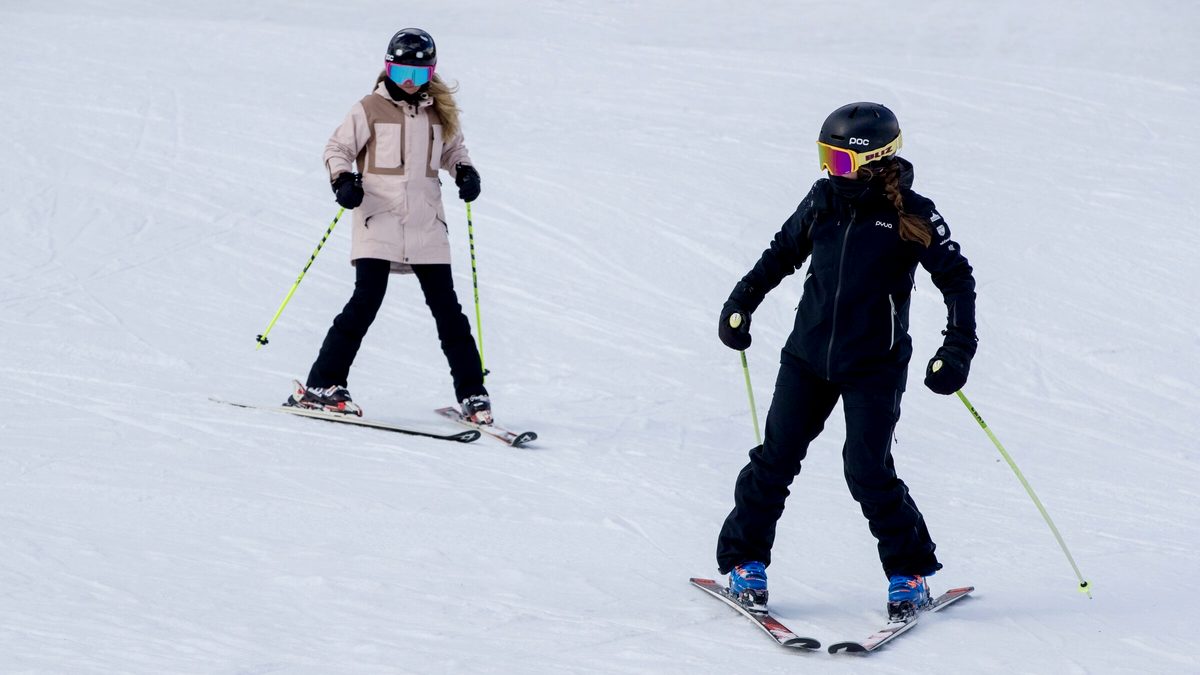
In autumn only the glacier is open. To reach it you take the Alpin Express, the Felskinn cable car and the Metro Alpin, then walk down a long, narrow path to the pistes. Up there the lifts are T-bars, not chairlifts, and two of them are steep. The snow is hard and icy in the morning and turns soft and bumpy after lunch. Almost everyone on the slopes is a racer or an advanced skier training for the season. It is a wonderful place for a strong skier who wants early turns. For somebody in a snowplough, it is tiring, intimidating and, frankly, not safe enough for us to recommend.
If your dates are fixed in November, write to us anyway. Depending on the snowfall the village area sometimes opens in the second half of the month, and we will tell you honestly whether a lesson makes sense or whether you should wait a few weeks. From December onwards the question disappears: the village slopes are open and a beginner has everything they need.
Altitude, weather and sun: what 1,800 m to 3,500 m means for a first-timer
The village sits at 1,800 m and the top of the ski area at 3,500 m, which makes Saas-Fee one of the highest resorts in the Alps. For a beginner this has three practical consequences.
Snow you can rely on. The height is the reason the village slopes keep their snow from December to April and why a first ski holiday booked in early December or late March is far less of a gamble here than in a lower resort. You will almost never learn on thin or artificial snow.
A slower pace up high. At 3,000 m and above you breathe harder and tire faster, and a beginner’s muscles are already working overtime. This is one reason we keep the first days low and go up only when the technique is solid. When you do go up, drink more water than you think you need, take breaks, and expect to feel the altitude in the first hour.
Strong sun and cold shade. The sun at altitude burns quickly, even in January, and the village slopes are in shade early and late in the day. High-factor sun cream, lip protection and goggles are not optional, and a beginner, who spends more time standing than skiing, should dress warmer than an experienced skier. Our checklist for a ski trip to Saas-Fee covers the layers in detail.
How a first ski week in Saas-Fee should look
The most common mistake beginners make is to book too much skiing. Learning to ski is physically and mentally demanding, and progress comes from short, focused sessions with rest in between, not from six hours a day. After more than fifteen winters of teaching beginners here, this is the rhythm we recommend for a first week.
| Day | Morning | Afternoon | Where |
|---|---|---|---|
| Arrival day | Travel, rental shop, pick up your lift pass | Walk the village, early night | Village |
| Day 1 | Private lesson: balance, sliding, stopping, first turns | Rest, or 45 minutes of practice on the same slope | Kalbermatten and Stafelwald |
| Day 2 | Private lesson: linked turns, speed control, first lift | Short practice, then stop while it still feels good | Village slopes |
| Day 3 | Private lesson: first mountain run with your instructor | Free afternoon, sauna or pool | Morenia |
| Day 4 | Rest day, or a short lesson if energy is high | Sledging, a walk to Hannig, a long lunch | Off the skis |
| Day 5 | Private lesson: longer blue runs, rhythm, confidence | Practice on known runs | Morenia |
| Day 6 | Private lesson: the blue at Längfluh or the flat drag lift on the glacier, depending on the weather | Celebrate | Längfluh or Mittelallalin |
A few notes on this plan. Private lessons are the format we teach, and for a beginner they are not a luxury: one instructor for you, or for your family or group of up to five people, means every minute is spent on your own technique and your own fears, and most of our adult beginners ski a blue run on day three. We usually suggest a 09:30 start, when the slopes are freshly groomed and quiet; if you prefer afternoons, we are happy to teach from 13:00, and some beginners learn better once they have warmed up. Our guide on morning versus afternoon lessons goes through the trade-offs. If you have only a long weekend, our three-day plan for first-time skiers compresses the same logic into three mornings.
Children and families with different levels
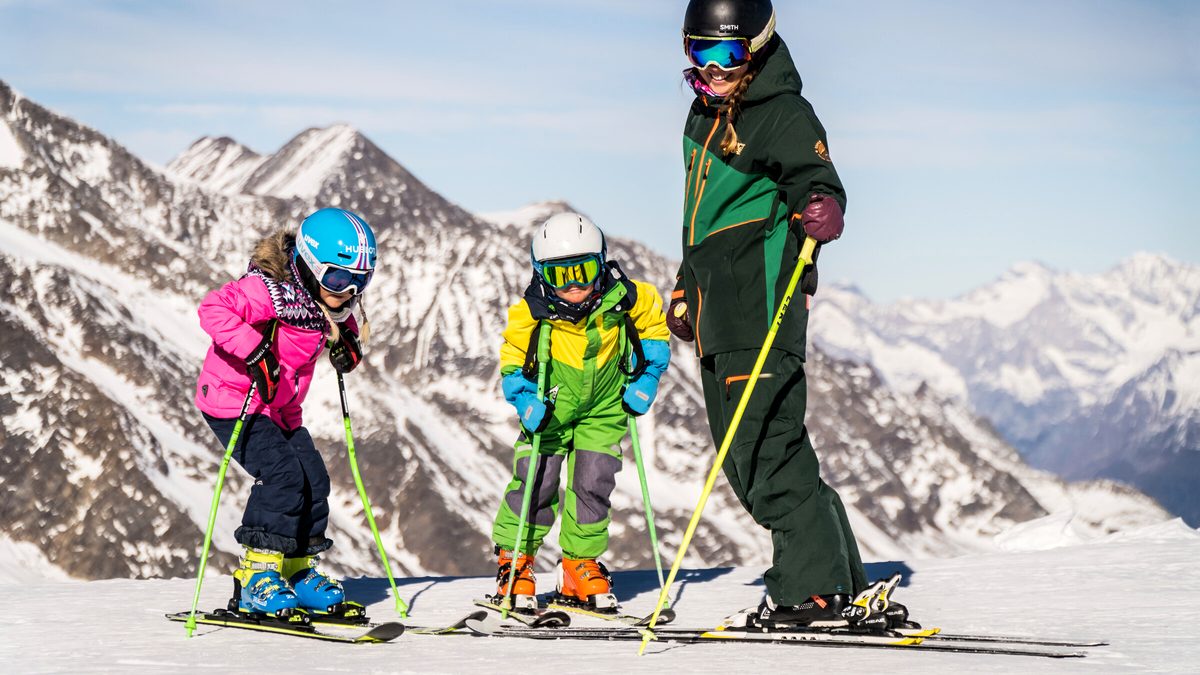
Saas-Fee works particularly well for families, and not only because the village is car-free. We teach children from the age of three, and the first lessons for small children are short, playful and close to the village, with the parents nearby but not on the slope. From about six or seven, children progress very quickly, and by the end of a week most of them are skiing the Morenia blues with a smile that their parents cannot match. Our guide to ski lessons for kids in Saas-Fee explains what a first lesson looks like at each age and what to bring.
The more common family problem is mixed levels: one parent skis, the other has never tried, the children are somewhere in between. In Saas-Fee this is easy to solve because the beginner area, the Morenia blues and the red runs of Plattjen and Längfluh all start from the same corner of the village. The experienced skier goes up the Alpin Express, the beginner has a lesson at Kalbermatten, the children have theirs, and everyone meets for lunch. Later in the week, when the beginner reaches Morenia, the family can ski together on the same blue runs. Tell us who is in your group and what each person can do, and we will build the week around that.
Saas-Fee vs Zermatt vs Grimentz-Zinal for beginners
Many people choosing a first ski holiday in the Valais hesitate between Saas-Fee and Zermatt, its famous neighbour one valley to the west, and some also look at the smaller villages of the Val d’Anniviers, where our sister school teaches. All three are good places to learn. They are not the same place to learn.
| For a beginner | Saas-Fee | Zermatt | Grimentz-Zinal |
|---|---|---|---|
| Village | Compact, car-free, 1,800 m | Large, car-free, 1,600 m, very lively | Small traditional villages, quiet |
| Beginner area | At the edge of the village, walkable | Up the mountain, reached by lift | At the top of the Grimentz gondola (Bendolla) |
| First mountain runs | Wide blues at Morenia, one lift from the village | Many blues, but spread over a very large area | Gentle, sunny blues around Bendolla |
| Snow reliability | Very high (glacier resort) | Very high (glacier resort) | High, north-facing slopes |
| Crowds in peak weeks | Moderate | Busy | Low |
| Lift pass | Part of the Magic Pass | Own pass, not Magic Pass | Part of the Magic Pass |
| Our school | Bespoke Snowsports Saas-Fee | No, but we take confident skiers there on a Ski Safari | Bespoke Snowsports Anniviers |
Our honest summary: Zermatt is the place to go if the Matterhorn, the size of the ski area and the après-ski matter most to you, and you accept that a beginner spends the first days away from the village on a mountain designed for experienced skiers. Grimentz-Zinal is the place for families who want calm, authentic villages and a gentle learning area, and who do not mind that there is less to do off the slopes; our colleagues have written about whether Grimentz is good for beginners from their side of the mountains. Saas-Fee sits between the two: a real resort with restaurants, shops and a lively centre, a beginner area you can walk to, the snow security of a glacier, and enough mountain above it that you will not run out of terrain for many winters to come.
Practical details: rental, passes, getting here, what to wear
Equipment. Rent, do not buy, for a first holiday. A good shop will give a beginner shorter, softer skis and, above all, boots that fit; a boot that hurts ruins more first weeks than any slope. Reserve in advance for the Christmas and February weeks. Our article on ski rental in Saas-Fee explains what to rent, what to buy and where.
Lift pass. For the first two or three days a beginner does not need the full area; ask about the options for the village lifts and upgrade when your instructor says you are ready for Morenia. If you stay overnight in the valley you receive the SaastalCard, which brings a number of advantages for families; our SaastalCard guide lists them.
Getting here and getting around. Saas-Fee is car-free: you leave the car in the garage at the entrance of the village or arrive by train and PostBus via Visp, and electric taxis take you and your luggage to your accommodation. Everything after that is on foot, which beginners appreciate more than anyone: no driving to the slopes in ski boots. Read getting around in Saas-Fee’s car-free village before you travel.
What to wear. Waterproof trousers and jacket, a warm mid-layer, thin ski socks, gloves rather than mittens for a first week (easier with poles and bindings), a helmet, goggles and sun cream. Beginners fall and stand around, so waterproof matters more than fashionable. The full list is in our ski trip checklist.
Frequently asked questions
Can a complete beginner learn to ski in Saas-Fee in one week?
Yes. With a private lesson every morning, most adult beginners ski their first blue run at Morenia on day three and spend the rest of the week building confidence on the wide blue runs above the village. The blue piste at Längfluh or the flat drag lift on the glacier at Mittelallalin is the usual finale at the end of the week.
Is Saas-Fee better than Zermatt for beginners?
For learning, usually yes. Saas-Fee has a beginner area at the edge of the village that you can walk to, a calmer atmosphere and wide blue runs one lift above the village. Zermatt has a bigger ski area and the Matterhorn, but its beginner terrain is up the mountain and the resort is busier. Both have excellent snow.
Can I learn to ski in Saas-Fee in October or November?
We do not recommend it. In autumn only the glacier is open: it is reached by a long path, served by steep T-bars, icy in the morning and shared with racers in training. The village slopes, where beginners learn, usually open in December. If your dates are fixed in late November, write to us and we will tell you honestly what is possible.
Are there green runs in Saas-Fee?
Switzerland does not use green runs. The easiest terrain is the beginner area at Kalbermatten and Stafelwald next to the village, followed by the blue runs at Morenia, which are wide and gentle enough for a second or third day on skis.
Do I need a full lift pass as a beginner?
Not for the first days. Ask about the options for the village lifts and upgrade once your instructor takes you up to Morenia. Saas-Fee is part of the Magic Pass, which is worth checking if you already hold one or plan to ski more than once this winter.
Is Saas-Fee good for adult beginners, not only children?
Very. A large share of the beginners we teach are adults, from people in their twenties learning with friends to guests in their sixties starting for the first time. Private lessons let us adapt the pace, the terrain and the amount of talking to each person, and nervous adults in particular learn faster when nobody else is watching.
How many lessons does a beginner need in Saas-Fee?
We recommend one private lesson a day for the first three days, then one or two more later in the week with practice in between. After five lessons most beginners can ski all the blue runs of Saas-Fee in control and enjoy the blue piste at Längfluh or the flat drag lift on the glacier with their instructor.
Which languages do your instructors teach in?
Our team is international. Lessons are given in English, German, French, Spanish, Dutch and Italian, and in other languages depending on the season’s team. Tell us your preferred language when you book and we will match you with the right instructor.
Ready to learn to ski in Saas-Fee?
If you have read this far, you already know more about learning to ski in Saas-Fee than most people who arrive here. The rest is simple: pick your dates between December and April, reserve your equipment, and tell us who is coming and what each person can do. We will match you with the right instructor, suggest the right number of lessons, and meet you at the bottom of the village on your first morning.