

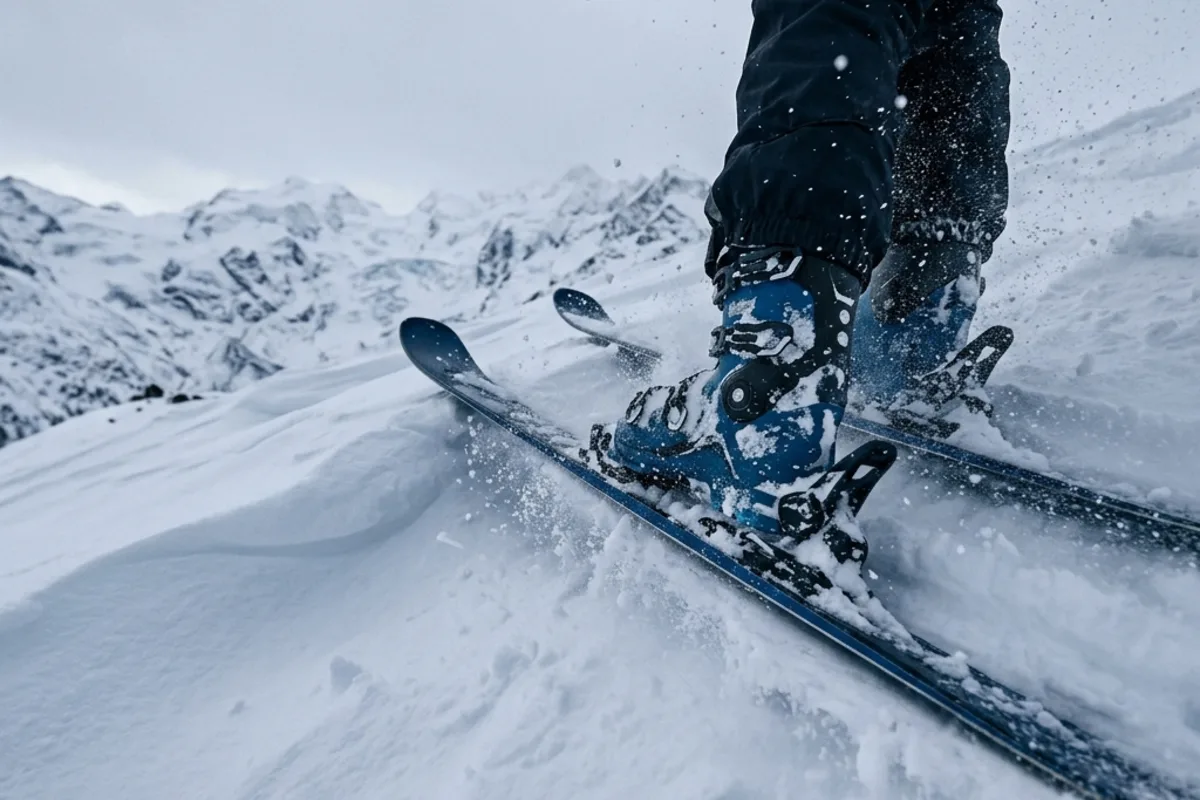
The sky is a uniform, brilliant white. The snow beneath your skis seems to merge with the horizon, erasing the texture, contours, and definition of the slope ahead. This is the classic flat light scenario, a common feature of high-alpine skiing that can turn a confident, fluid skier into a hesitant, tentative one.
Here in Saas-Fee, with our magnificent glaciers and high-altitude terrain, these conditions are part of the authentic mountain experience. While many skiers view flat light as a day-ruiner, we see it as one of the most effective training environments available.
It forces you to stop relying solely on your eyes and start truly feeling the mountain through your skis. This shift from visual to tactile skiing is where profound improvements are made, transforming your technique not just for cloudy days but for all conditions.
Instead of heading for a hot chocolate at the first sign of a whiteout, let’s reframe the challenge. This is an opportunity to refine your balance, sharpen your senses, and build a deeper connection with your equipment and the snow.
It’s about developing an internal sense of the terrain, a skill that separates good skiers from great ones. The techniques you develop to handle a low-visibility day on the Allalin will make you a more dynamic, adaptable, and confident skier on bluebird days on the Morenia slopes.
This guide will provide you with the technical adjustments, mental strategies, and local knowledge to not just survive, but thrive, when the clouds roll in over the Saas Valley.
Content
Foundational principles for low-visibility skiing
When visual information becomes unreliable, your entire system for processing the mountain needs to adapt. Your body must become the primary sensor, reading the subtle feedback coming up from the snow. This requires a shift in focus from looking for information far down the slope to feeling the information directly underfoot.
The goal is to create a stable, predictable platform that can absorb unseen variations in the terrain without throwing you off balance. This begins with a solid, athletic stance and a commitment to fluid, continuous movement.
Adjusting your stance for maximum stability
The foundation of all good skiing is a balanced, athletic stance, and its importance is amplified tenfold in flat light. When you can’t see a compression or a small bump ahead, your body needs to be in the optimal position to absorb it.
Think of your legs as the suspension system of a high-performance vehicle. To work effectively, that system needs to be engaged and ready. This means bringing your feet slightly closer together than you might on a sunny day.
A narrower stance, about hip-width apart, allows both skis to travel through similar terrain, reducing the chance of one ski getting caught on something the other missed, which can lead to being split and losing balance.
Your vertical position is also critical. Lower your center of mass by flexing more deeply in your ankles, knees, and hips. Avoid the common mistake of simply bending at the waist; this pushes your weight back and makes you vulnerable. Instead, focus on sinking down, keeping your shins pressed firmly against the front of your boots. This shin-to-boot contact is your lifeline.
It ensures your weight is forward and that you are connected to the front of your skis, allowing you to steer effectively and maintain control. Your hands should be forward, in your field of vision, as if you’re carrying a tray. This simple action helps keep your upper body stable and your weight centered over the middle of your skis.
The rhythm of the turn: Why continuous motion is your friend
Hesitation is the enemy in flat light. When you can’t see clearly, the instinct is to slow down, stiffen up, and make sudden, jerky movements. This is precisely the wrong approach.
Abrupt changes in speed or direction disrupt your balance and make you more susceptible to being knocked off-kilter by unseen terrain variations. The solution is to cultivate continuous, rhythmic motion. Link your turns together in a smooth, flowing sequence, almost like a dance. This constant movement keeps your skis engaged with the snow and provides a steady stream of tactile feedback to your brain.
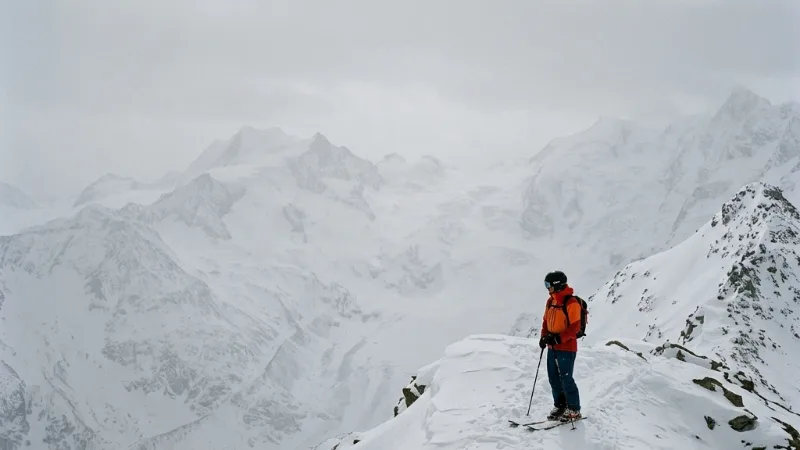
Focus on making round, complete turns. Avoid skidding or traversing for long distances, as this is when you are most likely to catch an edge on an unseen feature. By constantly changing your edge, you are actively probing the snow surface.
Each turn becomes a small experiment, telling you about the snow’s consistency and texture. Shortening your turn radius can also be extremely helpful. Shorter, quicker turns keep your speed under control naturally, without the need for abrupt braking.
This consistent rhythm improves stability and builds confidence, as you begin to trust that you can handle whatever comes your way, one turn at a time.
Feeling the snow: From visual to tactile skiing
This is the core concept that will change your relationship with flat light forever. You must learn to ski with your feet. On a clear day, your eyes scan the slope ahead, identifying bumps, dips, and changes in snow texture long before your skis reach them.
Your brain processes this visual data and pre-programs the necessary movements. In flat light, this preview is gone. Your feet and lower legs must become your eyes. The goal is to develop a heightened sensitivity to the pressure and vibrations transmitted through your boots.
To practice this, find a gentle, low-consequence slope. Close your eyes for a second or two (in a safe, open area) and focus entirely on what you feel. Can you sense the subtle shift in pressure as you roll your skis from one edge to the other? Can you feel the difference between soft, packed powder and a firmer, wind-blown patch? This is the information you need to tune into.
The constant pressure on your shins, as mentioned earlier, is a key indicator. If you feel that pressure release, it means your weight has shifted back. If you feel it increase suddenly, you might be entering a compression.
By paying close attention to these signals, you can react to the terrain as it happens, rather than after it has already thrown you off balance. This tactile awareness is the ultimate goal, turning a challenging condition into a deeply rewarding sensory experience.
Advanced techniques and mental strategies
Once you’ve established a solid foundation, you can begin to incorporate more advanced techniques and mental frameworks. These strategies are about proactively managing the terrain and your own psychological response to the uncertainty of flat light. It’s about taking control of the situation rather than simply reacting to it. This involves using the environment to your advantage and training your mind to remain calm and focused.
Using terrain markers for reference
One of the most disorienting aspects of flat light is the loss of a horizon and the sense of where the slope begins and ends. This is where you need to become a detective, actively searching for any source of definition in the white landscape.
Ski pole tracks, other skiers, trees, rocks, and piste markers are your best friends. These objects provide crucial reference points that give your brain the contrast it needs to perceive depth and orientation.
When visibility is poor, make a point of skiing closer to the edge of the piste, near the marker poles. The poles provide a consistent, repeating reference that can help you gauge your speed and the pitch of the slope.
Following another skier’s tracks can also be incredibly helpful, as their path will reveal the contours of the hill. If you’re with a partner, ski in a way that you can always see each other, providing a moving reference point.
The key is to keep your eyes scanning for these small islands of definition in the sea of white. Even a small patch of wind-scoured snow or a few exposed rocks can be enough to recalibrate your senses and restore your confidence. In Saas-Fee, the dramatic rock formations and the edges of the glacier can serve as powerful orientation guides, even when the sky and snow blend together.
The power of visualization and positive self-talk
The mental game is just as important as the physical one. When you can’t see, your brain tends to fill in the blanks with worst-case scenarios. You imagine huge drop-offs, massive moguls, and treacherous ice patches. This negative internal monologue creates tension in your body, which restricts your movement and makes you ski defensively. You must actively combat this with positive visualization and constructive self-talk.
Before you start a run, take a moment to visualize yourself skiing it with perfect, fluid technique. Imagine the feeling of round, smooth turns, your body perfectly balanced and absorbing the terrain effortlessly. During your descent, talk yourself through it. Use simple, instructional cues like “flex your ankles,” “hands forward,” “look for the next pole,” or “finish the turn.”
This internal coaching keeps your mind focused on the process and leaves no room for fear to creep in. Remind yourself that you have the skills to handle the conditions. Every completed turn is a success. Celebrate it and move on to the next one. This positive feedback loop builds momentum and replaces anxiety with a sense of accomplishment and control.
Equipment considerations for low-visibility days
While technique is paramount, having the right equipment can make a significant difference in your comfort and performance. The most impactful piece of gear for flat light is your goggles. Goggle lenses are designed to filter light in specific ways to enhance contrast and definition. For overcast and flat light days, you need a lens that allows a high percentage of visible light transmission (VLT) to pass through.
Look for lenses in shades of yellow, amber, rose, or pink. These colors are highly effective at filtering out blue light, which is prevalent on cloudy days, and this filtering helps to make shadows and subtle contours in the snow more apparent. Many modern goggles feature quick-change lens systems, making it easy to swap to a low-light lens when the clouds roll in. It’s a worthy investment. A clean, unscratched lens is also vital.
A single smudge or scratch can create a halo effect that further obscures your vision. Take the time to properly care for your goggles, using only the soft bag they came with to clean the lens. Additionally, ensure your skis are well-maintained. Sharp edges will provide a more reliable grip on firm snow that you might not see, adding an extra layer of security and confidence.
Drills and exercises to build your flat light skills
Confidence in challenging conditions isn’t something you’re born with; it’s built through deliberate practice. The best time to work on these skills is actually before you need them, on days with better visibility. By isolating specific movements and feelings, you can hardwire them into your muscle memory so they become automatic when the world turns white. These drills are designed to take you out of your comfort zone in a controlled way, sharpening the senses you’ll rely on when visibility drops.
The “White Room” drill
This exercise is designed to simulate the sensory deprivation of a whiteout. Find a wide, gentle, and empty piste. As you ski, consciously try to “soften” your gaze. Instead of focusing intently on a point down the hill, relax your eyes and take in your broad peripheral vision. Then, for a single, complete turn, close your eyes. Focus all your attention on the feeling in your feet. Feel the pressure build on your downhill ski as you move through the arc of the turn. Feel the transition as you release that pressure and roll onto the new edge. Open your eyes, and then repeat on the next turn.
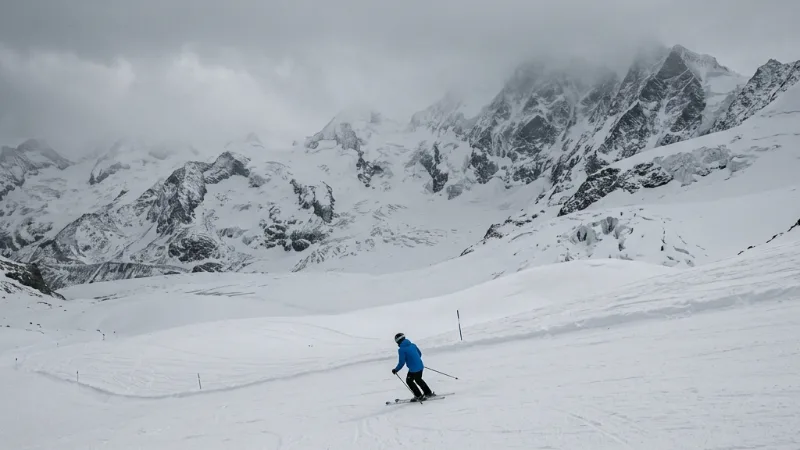
Start with very short durations and gradually increase the time your eyes are closed as you become more comfortable. This drill forces you to trust your body’s ability to maintain balance and execute a turn without visual input.
It directly trains the tactile feedback loop we discussed earlier, teaching you to interpret the language of the snow. You’ll quickly discover how much you can perceive through your feet alone. This is a powerful drill, but safety is paramount. Only practice it on familiar, gentle terrain, well away from other people or obstacles.
Pole-plant rhythm exercises
In flat light, a well-timed pole plant does more than just initiate a turn; it acts as a probe, giving you a physical connection to the snow and helping you maintain rhythm and timing. A rhythmic pole plant is like a metronome for your skiing, keeping your turns consistent and your body moving forward down the fall line. To practice this, focus on making a distinct “tap” with your pole at the initiation of every single turn. The movement should come from the wrist, not the whole arm.
Try to create a consistent cadence: tap-turn, tap-turn, tap-turn. You can even say it out loud to yourself to reinforce the rhythm. This exercise helps prevent you from getting stuck on your edges or traversing for too long.
The physical act of reaching your pole forward and down the hill also helps keep your weight in the correct forward position. On a day with poor visibility, this consistent rhythm can be incredibly reassuring, providing a predictable structure to your skiing when the terrain itself feels unpredictable.
The absorption and extension drill
This drill trains your legs to act as an independent suspension system, capable of absorbing unseen bumps and dips without affecting your upper body’s stability. The goal is to learn to actively flex and extend your legs to manage terrain changes. Find a slope with some gentle, rolling terrain.
As you ski over a small rise or compression, consciously pull your feet and knees up towards your chest, absorbing the feature by flexing deeply. As you ski into a dip or the backside of a roller, actively push your feet away from you, extending your legs to maintain contact with the snow.
Imagine your upper body and head floating along at a constant level, while your legs do all the work underneath you, like pistons. You can place your hands on your hips to monitor any unwanted up-and-down movement of your torso. This drill teaches active terrain management.
Instead of being a passive passenger who gets bounced around, you become the pilot, dictating how your skis interact with the snow. This proactive approach is precisely what’s needed when you can’t see the bumps coming.
Putting it all together in Saas-Fee
Now, let’s apply these concepts directly to the terrain we have here in the Saas Valley. Our unique high-alpine environment, with its expansive glaciers and wide-open bowls, presents both the challenge and the perfect training ground for mastering low-visibility skiing. The skills you develop here will make you a better skier anywhere in the world. Our team at Bespoke Snowsport believes that every condition is an opportunity to learn, and flat light is one of the best teachers.
Navigating specific Saas-Fee runs
When the clouds descend on the Mittelallalin, the vast, open glacier can feel particularly disorienting. This is the perfect place to use the terrain marker strategy. Stick to the sides of the main pistes, using the piste poles as your guide.
The runs leading down from the Felskinn cable car station often have more definition, with rock outcroppings and varied terrain that can provide valuable contrast. The Morenia area, with its rolling terrain, is an excellent place to practice the absorption and extension drills we covered. The gentle pitch allows you to focus on your leg movements without worrying about excessive speed.
Even a familiar run like the Kanonenrohr can feel entirely different in flat light. The steep pitches demand a commitment to rhythmic, short turns. Don’t be afraid to use the fall line; traversing on steep slopes in poor visibility is where people often get into trouble.
A confident, rhythmic descent down the center of the piste is often the safest and most efficient way down. Remember, the goal is not to ski fast, but to ski with fluid, continuous motion. This is one of the core tenets of our teaching philosophy: control and rhythm are the parents of speed.
The benefits of professional guidance
Reading about techniques is one thing; putting them into practice under the watchful eye of an expert is another. This is where personalized instruction can make a world of difference. An experienced instructor can provide real-time feedback, helping you correct small errors in your stance or timing that you might not even be aware of.
They can choose the perfect terrain to challenge you appropriately, building your confidence one step at a time in a safe and controlled environment. We can follow you, providing a clear track to ski in, or ski ahead, offering a constant visual reference point.
We often use video analysis to show you exactly what’s happening with your technique, making the feedback tangible and easy to understand. For many skiers, a single session focused on developing these specific skills can be a breakthrough moment.
The confidence gained from successfully navigating a challenging run in flat light with an instructor by your side is immense and carries over to all aspects of your skiing. It’s an investment in your safety, your enjoyment, and your overall development as a skier. The team at Bespoke Snowsport is dedicated to providing this level of elite, personalized coaching.
A final word on safety and mindset
It’s important to know your limits. There’s a difference between challenging flat light and a dangerous, complete whiteout where you can’t see your own ski tips. If conditions deteriorate to the point where you feel unsafe or completely disoriented, it’s always the right decision to stop. Never ski alone in poor visibility, and always stay on marked pistes. The off-piste terrain around Saas-Fee is serious, with hidden crevasses and other hazards that are impossible to spot in flat light.
Embrace the challenge, but respect the mountain. The true goal of practicing these skiing in flat light Saas-Fee tips is not to become reckless, but to become so competent and confident in your core skills that you can make smart, safe decisions no matter the weather. It’s about expanding your comfort zone, not abandoning common sense. With the right approach, a cloudy day in Saas-Fee can be one of the most productive and rewarding days you’ll ever have on skis.
Flat light is not a barrier to a great day on the mountain; it’s an invitation to become a more intuitive, skilled, and resilient skier. By focusing on a solid stance, continuous rhythm, and learning to feel the snow, you can transform a challenge into a strength. If you’re ready to build your confidence and unlock your full potential in all conditions, our team is here to guide you. We invite you to request any of our ski services, whether it be a private or group lesson, and let us show you how to truly see the mountain, even when your eyes can’t.