


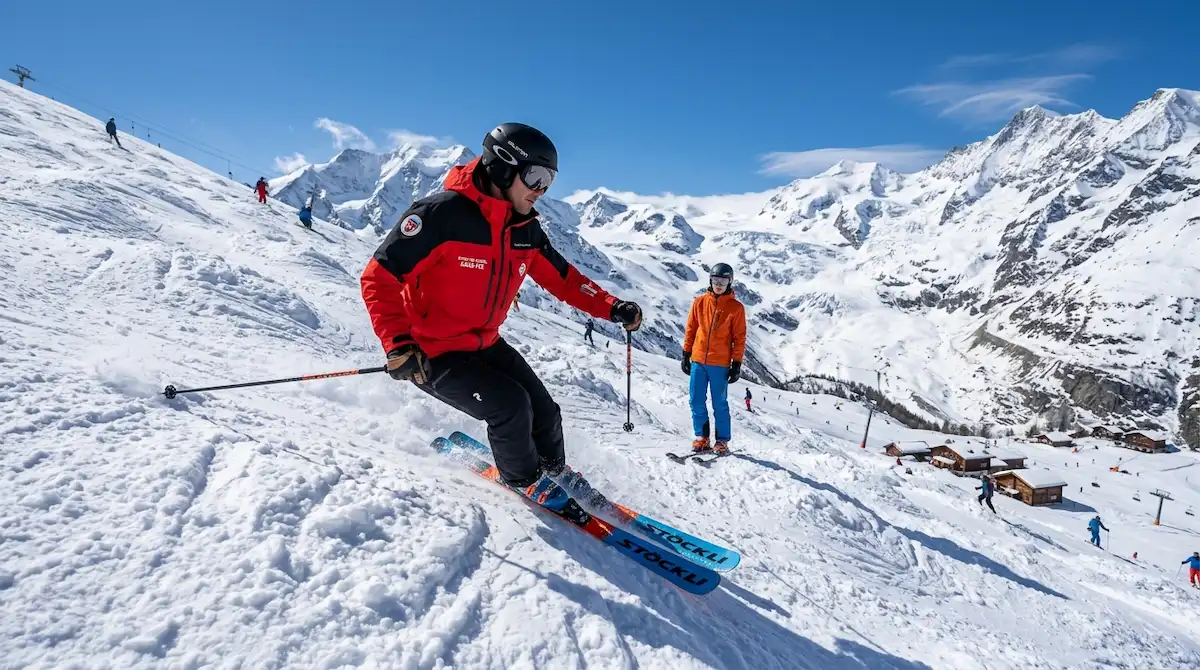
The sight of a perfectly zipper-lined mogul field can evoke two distinct reactions in skiers. For some, it’s a thrilling playground, a rhythmic dance of bumps and turns. For many others, it’s a field of intimidating obstacles, a leg-burning challenge to be avoided. The difference between these two perspectives isn’t raw talent or fearlessness; it’s technique.
Skiing bumps gracefully is a learned skill, a combination of specific movements, timing, and an in-depth understanding of how your body and skis interact with variable terrain. It’s about transforming a chaotic-looking slope into a predictable and enjoyable descent. This is where a focused approach to learning can completely change your relationship with one of skiing’s most rewarding disciplines.
Many skiers who are perfectly comfortable on steep, groomed runs find themselves struggling in the moguls. Their balance feels off, their legs fatigue quickly, and control seems to evaporate with each bump. This is a common experience, and it stems from trying to apply groomed-run techniques to a three-dimensional environment. Mogul skiing requires a different mindset and a refined skillset.
It demands that you work with the mountain, not against it, using the bumps as tools to facilitate your turns rather than as obstacles to fight. The goal is to find a fluid, continuous line where your body acts as a suspension system, absorbing the terrain while your skis maintain constant contact with the snow.
With the right instruction and practice, any competent parallel skier can learn to find this flow and turn a dreaded mogul run into the best part of their day on the mountain.
Content
The fundamental principles of bump skiing
Before diving into the specific movements, it’s crucial to understand the foundational concepts that govern effective mogul skiing. These principles are the bedrock upon which all advanced techniques are built. They revolve around maintaining balance, managing energy, and creating a consistent rhythm.
Without a solid grasp of these fundamentals, even the most athletic skiers will find themselves fighting the terrain instead of flowing with it. Think of this as recalibrating your skiing instincts for a new and more dynamic environment. The goal is to become proactive rather than reactive, anticipating the terrain and dictating your path through it.
These principles are not just theoretical; they have a direct impact on your physical performance and energy expenditure. A skier with poor fundamental technique will use brute force to get down a mogul field, leading to rapid fatigue and a higher risk of losing control.
A skier with strong fundamentals, however, will use the terrain’s energy to their advantage, making the descent feel smoother, more efficient, and significantly less tiring. This efficiency is the hallmark of an expert bump skier. It’s what allows them to ski run after run without their performance degrading. Our focus is on building this efficient foundation from the ground up, ensuring every movement has a purpose.
Body position and balance: The athletic stance revisited
The athletic stance you use on groomers is the starting point, but in moguls, it needs to be more dynamic and adaptable. Your center of mass must remain stable over the base of support provided by your feet, even as the ground beneath you is constantly changing pitch and angle. This means maintaining a slightly wider stance than on a flat slope for increased stability.
Your hands should be forward, in your field of vision, acting as outriggers that help you maintain balance. Think of a tightrope walker using their arms; your hands and poles serve a similar purpose.
Crucially, your shins should maintain light but consistent contact with the front of your ski boots. This ensures you are pressuring the front of the skis, which is essential for initiating turns quickly and effectively in the tight confines of a mogul trough. A common mistake is for skiers to get pushed into the “back seat,” with their weight over their heels.
This makes turning incredibly difficult and is the primary cause of losing control in the bumps. We constantly drill the feeling of forward pressure, ensuring it becomes second nature. Your ankles, knees, and hips should be flexed and loose, ready to act as your body’s suspension system. A rigid body cannot absorb the terrain; a fluid, athletic body can.
The role of absorption and extension
If there is one secret to mogul skiing, it is the mastery of absorption and extension. This is the vertical movement of your body that allows you to manage the terrain. As you approach the front side of a mogul, you must actively absorb it by pulling your feet and knees up towards your chest.
This flexion shortens your legs, allowing the bump to pass underneath you without launching you into the air. Your upper body should remain quiet and relatively level, moving smoothly down the fall line while your legs do all the work underneath you. This is what creates the illusion of a skier gliding effortlessly over the tops of the bumps.
Conversely, as you ski into the trough or the backside of the mogul, you extend your legs to push your skis back down onto the snow. This extension is what keeps your skis in contact with the snow, providing the grip and platform you need to initiate the next turn. Without active extension, your skis would chatter or lose contact with the snow entirely, resulting in a loss of control.
The cycle of absorption (flexion) on the bump and extension (lengthening) in the trough is the engine of mogul skiing. It’s a continuous, fluid motion that must be timed perfectly with the terrain. Mastering this rhythmic vertical movement is a primary goal in our mogul skiing technique lessons in Saas-Fee, as it is the key to unlocking flow and efficiency.
Pole planting: Your rhythm section
In mogul skiing, the pole plant is not just an afterthought; it is an essential tool for timing and rhythm. It acts as the metronome for your turns. A well-timed pole plant provides a point of stability and helps initiate the rotation of your upper body into the next turn. The plant should be a light tap, not a heavy push. It occurs just before you reach the crest of the mogul you plan to turn on. As you plant your downhill pole, it helps to pull your body forward and down the fall line, preventing you from getting stuck on top of the bump.
The placement of the pole plant is critical. You should plant it on top of the mogul or slightly to the downhill side of it. This provides a pivot point around which you can turn your skis in the trough. A common error is planting the pole too late or too far down the hill, which disrupts the rhythm and throws off your balance.
We teach a specific “touch and go” technique, where the pole plant is a quick, light, and precisely timed action that seamlessly integrates with the movements of your lower body. It’s the final piece of the puzzle that brings the entire sequence of movements together into a coordinated, rhythmic dance down the mountain.
Mastering the three key movements
With the fundamental principles established, we can now focus on the three distinct yet interconnected movements that constitute a mogul turn: the turn itself, the pressure management, and the line choice. These are the active skills you will be executing on every single bump. While we break them down individually for learning purposes, the ultimate goal is to blend them into one seamless, subconscious action.
An expert mogul skier isn’t thinking, “Now I will absorb, now I will turn, now I will extend.” They are simply feeling the rhythm of the mountain and reacting instinctively. Our coaching process is designed to build this muscle memory through targeted drills and progressive exercises, taking you from conscious incompetence to unconscious competence.
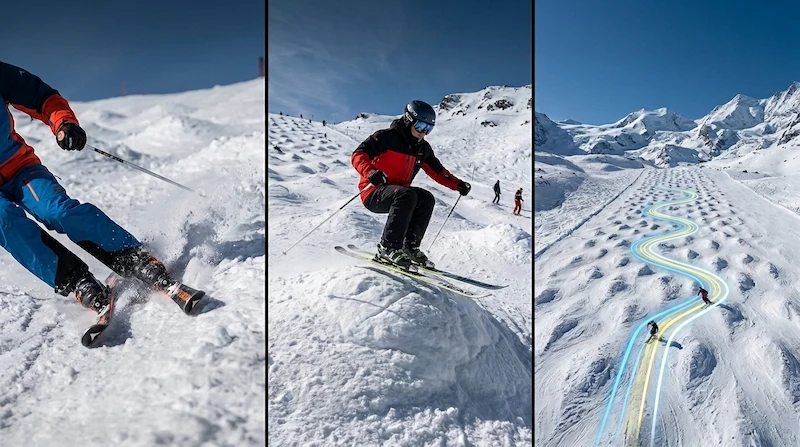
Each of these movements addresses a different challenge presented by the mogul field. The turn addresses direction change in tight spaces. Pressure management addresses the constantly changing forces on your body and skis. Line choice addresses the strategic element of navigating the terrain.
Excelling at one without the others will lead to an unbalanced and inefficient performance. For example, a great turn is useless if you can’t manage the pressure through the bump, and a perfect line is impossible to follow if you can’t execute the turns required to stay on it. True mastery comes from the synthesis of all three elements.
The turn: Pivoting and steering in the troughs
Turns in moguls are fundamentally different from the wide, arcing carved turns you make on a groomer. The space is limited, and the transitions are rapid. Therefore, mogul turns rely more on pivoting and steering than on deep edge engagement. The turn is initiated at the top of the mogul, but the majority of the direction change happens on the backside of the bump and in the trough.
As you absorb the front of the mogul, you unweight your skis, making them easy to pivot. As you crest the bump, you begin to steer your feet and skis in the direction of the new turn.
The most effective technique is a short-radius, skidded turn where the tails of the skis slide or “smear” around. This allows for rapid direction changes and excellent speed control. The goal is to use the trough between the moguls as a banked turn, similar to a berm on a mountain bike trail. You steer your skis down into the trough, and the shape of the terrain helps to complete the turn.
It’s a common misconception that you need to ski over the very top of every mogul. More often, you are turning around them, using their sides and the troughs as your pathway. We use specific drills to develop the leg-steering skills required for this, teaching you to turn your skis independently from your upper body, which should remain facing downhill.
The pressure: Managing forces on the bumps
A mogul is essentially a small hill. As you ski up the front side, compressive forces build up, and as you ski down the back side, you become lighter. Effectively managing these pressure changes is critical to staying in control.
The absorption movement we discussed earlier is the primary tool for managing the compression on the front of the bump. By flexing your joints, you dissipate the upward force, preventing it from throwing you unbalanced or into the air. Think of it like the suspension on a car smoothing out a bumpy road.
On the backside of the bump, active pressure control is equally important. This is where you use extension to push your skis back onto the snow, maintaining edge grip. However, you must modulate this pressure. Pushing too hard can cause your edges to hook up unexpectedly, while not pushing enough can lead to a lack of grip. The ideal is a progressive application of pressure through the bottom of the turn in the trough.
This requires a sensitive feel for the snow and is a skill developed through mileage and focused practice. We teach skiers to feel the pressure building and releasing through their feet, making micro-adjustments in ankle and knee flexion to maintain a constant, manageable level of pressure throughout the turn cycle.
The line: Reading the terrain like a map
Choosing your line is the strategic element of mogul skiing. It’s about looking ahead and picking a path through the bumps, not just reacting to the one directly in front of you. There isn’t one single “correct” line; the best line depends on the shape of the moguls, the steepness of the pitch, and your personal skill level and speed preference. A beginner might choose a wider, more circuitous route that offers more space for turning. An expert might choose the “zipper line,” a direct path down the fall line that involves turning on the top of every bump.
The key is to always be looking ahead, typically three to four moguls down the slope. This gives your brain time to process the terrain and send the right signals to your body. If you only look at the mogul right in front of your skis, you will always be in a reactive mode, constantly surprised by the terrain. By looking ahead, you become proactive.
You can spot irregularities in the pattern, identify larger or smaller bumps, and plan your turns in advance. We teach a method of “connecting the dots,” where you visually link the spots you want to turn on, creating a mental map of your descent before you even get there. This forward-thinking approach is what separates fluid, controlled mogul skiers from those who appear to be pinballing down the slope.
Common mistakes and how to fix them
Every skier learning to navigate the bumps will encounter a set of common challenges. Identifying these pitfalls is the first step toward correcting them. It’s important to remember that these are not signs of failure but rather natural parts of the learning process. Even professional skiers constantly refine their technique to eliminate small inefficiencies.
The key is to have the awareness to recognize a mistake and the knowledge to apply the correct fix. Our coaching philosophy is centered on providing immediate, constructive feedback to help you build good habits and break bad ones quickly.
The following are some of the most frequent issues we see on the slopes of Saas-Fee. By understanding what they are and why they happen, you can begin to self-diagnose and correct your own skiing. We’ll explore the root cause of each problem and provide a concrete, actionable solution that you can practice. This proactive approach to error correction accelerates the learning curve dramatically and builds a more resilient, adaptable skier.
Getting into the “back seat”
This is arguably the most common and debilitating mistake in all of skiing, and its consequences are magnified in the moguls. Getting into the back seat means your weight has shifted too far back, over the tails of your skis. This happens when a bump pushes you backward and you fail to absorb it or make a forward move. Once your weight is back, it becomes nearly impossible to steer your skis effectively. The tips will rise, you’ll lose edge grip, and your quadriceps will burn as they struggle to pull you forward again. It’s a position of weakness and instability.
The fix involves a conscious and constant effort to move your center of mass forward. This starts with the athletic stance: hands forward, shins pressed against the front of your boots. A great drill is to practice skiing while trying to drag the tips of your poles in the snow on either side of you. This forces you to keep your hands forward, which in turn helps keep your body weight forward.
Another key is to actively think about moving your hips and torso forward over your feet as you crest each mogul. It should feel like you are perpetually falling forward down the hill, always catching yourself with the next turn. This forward-oriented mindset is crucial for staying in control.
Looking at your ski tips
Your body goes where your eyes go. If you are staring down at the mogul directly in front of your skis, you are setting yourself up for failure. This habit gives you no time to prepare for the next bump, forcing you into a constant state of reaction. It also tends to make you fold at the waist, which can throw your balance off and push you into the back seat. You are essentially driving a car by looking at the hood ornament instead of the road ahead. The result is a jerky, uncontrolled descent.
The solution is simple in concept but requires discipline to implement: look ahead. Force yourself to lift your chin and look three to four moguls down the fall line. Pick a feature in the distance—a tree, a lift tower, another skier—and focus on it periodically to ensure your gaze stays elevated. As discussed in the “line choice” section, this allows you to read the terrain and plan your route.
A practical drill is to have a partner ski ahead of you and follow their line. This forces you to look up and anticipate their movements, naturally training you to look further down the hill. Over time, this becomes a subconscious habit, and you’ll find the bumps seem to slow down, giving you more time to react.
A rigid upper body and stiff legs
Fear and uncertainty often cause skiers to tense up. A rigid body cannot effectively absorb the terrain. Stiff legs act like a rigid suspension, causing you to be launched into the air by every bump. A stiff upper body prevents the necessary rotation for turning and makes it difficult to maintain balance. The energy from the bumps travels directly through your skeleton, jarring your body and leading to rapid fatigue and a loss of control. Fluidity is impossible without relaxation.
The fix is to consciously focus on relaxation and independent body part movement. Your lower body (ankles, knees, hips) should be active and fluid, constantly flexing and extending. Your upper body, from the waist up, should be quiet, stable, and facing downhill. One of the best ways to achieve this is through dissociation drills.
Practice on a gently groomed slope, keeping your upper body perfectly still and facing down the fall line while making short, quick turns with just your legs. This teaches your body to separate the movements of its upper and lower halves. When you take this skill to the moguls, you’ll be able to keep your torso calm and balanced while your legs do the dynamic work of absorbing the terrain below.
Preparing for your mogul adventure in Saas-Fee
Success in the bumps begins before you even click into your skis. Proper preparation involves having the right equipment, being in good physical condition, and adopting the correct mental approach. The unique high-alpine environment of Saas-Fee, with its reliable snow and varied terrain, provides an ideal classroom, but you’ll get the most out of it by being prepared.
Taking a few steps to set yourself up for success can make a world of difference in your confidence and rate of progression. At our school, we see this as part of the overall coaching experience—ensuring you’re ready in every aspect.
This preparation is not about buying the most expensive gear or spending months in the gym. It’s about making smart, informed choices that support your specific goal of improving your mogul skiing. A few small adjustments to your equipment and a basic level of ski-specific fitness can prevent common frustrations and allow you to focus entirely on technique during your time on the snow. Let’s look at the key areas to consider.
Equipment considerations: Skis, boots, and poles
While you can ski moguls on almost any ski, some are better suited than others. An ideal mogul ski is relatively soft in flex, especially in the tip, and has a shorter turning radius. The soft flex helps the ski bend and absorb the bumps, while the shorter radius allows for quick, nimble turns in tight spaces. Overly stiff, wide, or heavy skis can be cumbersome and difficult to manage.
If you’re serious about bump skiing, consider a ski with a waist width in the 75-85 mm range. Your boots are your connection to the skis and are arguably the most important piece of equipment. They must fit well and provide a good balance of support and forward flex. A boot that is too stiff will inhibit the ankle flexion needed for absorption.
Pole length is also a factor. For mogul skiing, many experts prefer a slightly shorter pole than they would use for all-mountain skiing. A shorter pole is quicker to plant and less likely to get tangled up in the dynamic movements of your body. The difference may only be 5 centimeters, but it can have a noticeable impact on the quickness and rhythm of your pole plants. We can help you assess your current equipment and make recommendations during a lesson.
Physical conditioning for bumps
Mogul skiing is physically demanding. It requires a strong core, powerful legs, and good cardiovascular endurance. A strong core is essential for maintaining balance and a stable upper body. Exercises like planks, leg raises, and Russian twists are excellent for building core strength. Your legs, particularly your quadriceps and glutes, will be working constantly to absorb bumps and power through turns.
Squats, lunges, and box jumps are fantastic for building the necessary leg power and endurance. Finally, good cardio fitness will allow you to ski longer runs without becoming exhausted and losing your form. Activities like running, cycling, or swimming in the off-season will pay huge dividends on the mountain.
Flexibility and mobility are also key. Tight hips and hamstrings can restrict your range of motion, making it difficult to achieve the deep flexion required for absorption. Incorporating a regular stretching or yoga routine can improve your mobility and reduce the risk of injury. You don’t need to be a professional athlete, but arriving with a good baseline of fitness will allow you to focus more on technique and less on just surviving the run.
| Common approach (less effective) | Bespoke Snowsport method (more effective) |
|---|---|
| Trying to ski over the top of every mogul. | Using the troughs and sides of the bumps to turn, creating a smoother line. |
| Using wide, carved turns from groomer skiing. | Teaching a short-radius, pivoted turn with leg steering for quick direction changes. |
| A stiff body that gets bounced around by the terrain. | Focusing on active absorption and extension, using the legs as suspension. |
| Looking down at the ski tips, reacting to each bump. | Training the skier to look 3-4 bumps ahead, proactively choosing a line. |
| Relying on upper body rotation to turn. | Emphasizing a quiet upper body and using leg rotation for precise ski control. |
The journey to becoming a confident and stylish mogul skier is one of the most fulfilling in the sport. It challenges you, pushes your limits, and ultimately rewards you with the ability to ski the entire mountain with grace and control. The varied and challenging terrain here in Saas-Fee provides the perfect canvas for this journey.
Our personalized approach ensures that we identify your specific needs and build a progression plan that works for you, transforming intimidating bump fields into your personal playground. If you are ready to change your perspective on moguls and unlock a new level of skiing, we are here to guide you every step of the way.
Whether you’re taking your first tentative turns into a mogul field or you’re an experienced skier looking to perfect your zipper line, personalized coaching can accelerate your progress and refine your technique.
We tailor our instruction to your individual goals and learning style, providing clear, actionable feedback in a supportive environment. Let our team of expert instructors show you the path to rhythmic, fluid, and fun mogul skiing. To begin your transformation and see the mountain in a whole new way, request any of our ski services, whether it be a private or group lesson.