


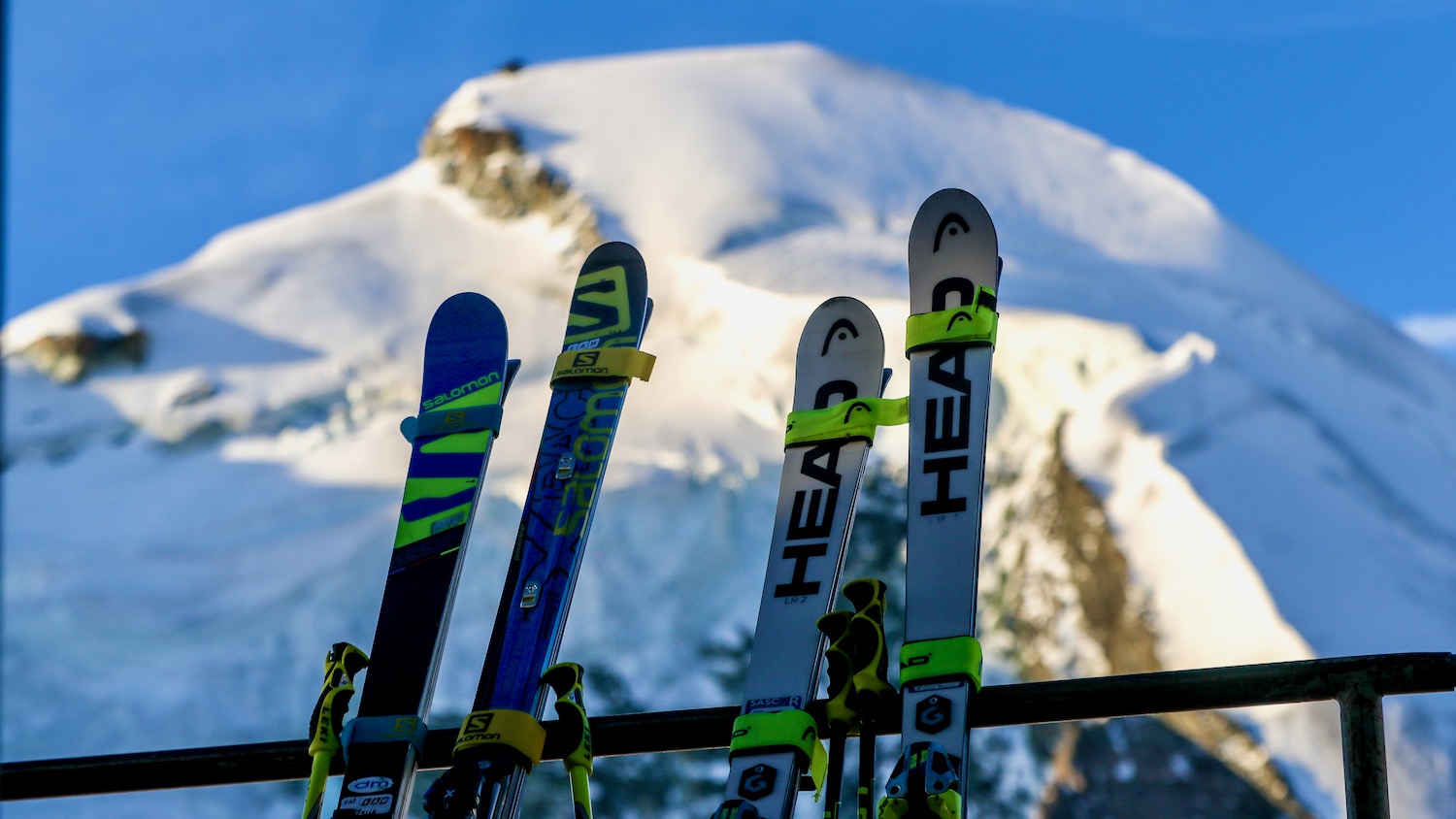
Skiing in the high-altitude environment of Saas-Fee offers some of the most spectacular terrain in the Swiss Alps. The glacier provides a consistent surface that is perfect for those who want to refine their movements and reach a higher level of technical proficiency.
Many skiers find themselves hitting a plateau where they feel they are doing everything correctly, yet the results on the snow do not match their internal perception. This is where the integration of ski video analysis in Saas-Fee becomes a game-changer for your progress. Seeing yourself on screen removes the guesswork and provides a clear path toward improvement.
The gap between what a skier feels and what is actually happening is often quite large. You might feel like you are leaning forward and engaging your edges early in the turn, but the camera might show a different story.
By using visual ski coaching, we can bridge that gap quickly. This method allows you to see the specific angles of your body, the timing of your weight shifts, and the precision of your pole plants. In a place as demanding as the Allalin glacier, having this level of detail is helpful for anyone looking to move beyond their current limits.
Working on your skills in Saas-Fee means you have access to long, sustained runs that allow for repetitive practice. When we combine this terrain with digital ski analysis, the learning curve becomes much steeper.
Instead of spending days trying to figure out why a certain turn feels unstable, you can look at the footage and identify the exact moment the balance is lost. This immediate feedback loop is what separates high-end instruction from a standard lesson. It is about being precise, efficient, and focused on the specific needs of your biomechanics.
Personalized instruction is the core of what makes a mountain experience memorable. Whether you are a teenager looking to enter the world of competitive skiing or an adult wanting to feel more secure on steep black runs, the use of video provides a level of clarity that words alone cannot achieve.
It is one thing for an instructor to tell you to move your hips more; it is another thing entirely to see how your hip position affects your edge grip in real-time. This visual evidence builds confidence and helps you internalize the correct movements much faster than traditional methods.
Content
The science behind visual ski coaching and skill acquisition
The human brain processes visual information much faster than auditory cues. When you are skiing, you are managing a massive amount of sensory input—the wind, the texture of the snow, the speed, and the people around you. Trying to listen to technical advice while moving at 30 miles per hour can be difficult.
That is why performance ski training relies so heavily on the review process. When you stop and look at the footage, your brain can map the visual image of your body onto the physical sensation you just experienced. This creates a stronger neural connection, making it easier to replicate the correct movement on the next run.
In Saas-Fee, the light conditions on the glacier are often perfect for high-quality filming. This clarity allows us to look at the fine details of your equipment interaction. We can see how the ski flexes under your weight and whether your boots are providing the necessary support for your lateral movements.
Many people do not realize that their technique is often limited by a small misalignment that only becomes visible when slowed down to 60 frames per second. By using ski technique correction, we can address these micro-movements that make a macro difference in your overall stability.
Another important aspect of using video is the ability to compare your turns with those of professional athletes or your previous sessions. Seeing your progress over a few days is incredibly motivating. You can see the evolution of your stance from being defensive and back-weighted to being offensive and balanced over the center of the ski.
This progression is documented, providing you with a library of your own development. It turns a simple ski holiday into a structured and rewarding educational experience that stays with you long after you leave the Saas Valley.
The process of ski instructor feedback is also enhanced by these digital tools. Instead of general encouragement, the dialogue becomes technical and specific. We can draw lines on the screen to show the “V” shape of your legs or the angle of your shins relative to the slope.
This objective data makes it easier for you to understand the “why” behind every correction. When you understand the physics of the turn, you are no longer just following instructions; you are learning how to manage the forces of skiing yourself.
Improving your edge control through digital ski analysis
Edge control is the foundation of modern carving, especially on the firm, groomed runs of Saas-Fee. Many skiers struggle with “skidding” their turns because they engage the edge too late or with too little pressure.
Through digital ski analysis, we can pinpoint the exact frame where the edge engages. If the ski is flat for too long at the start of the turn, you lose the ability to use the ski’s sidecut to your advantage. Seeing this on video helps you understand the importance of the “inclination” and “angulation” movements required to get the ski on edge early.
The terrain in Saas-Fee, with its consistent pitch, allows us to film multiple turns in a row. This is helpful for seeing if your technique is symmetrical. Most people have a “strong side” and a “weak side.”
You might find that your right turns are carved perfectly, while your left turns involve a slight hip drop or a shoulder rotation. Identifying these patterns is the first step toward fixing them. Once you see the asymmetry on the screen, you can focus your mental energy on correcting that specific side, leading to a much more fluid and balanced style of skiing.
We also look at the transition between turns. This is often where the most mistakes happen. A common issue is staying “stuck” on the old edge for too long, which delays the start of the new turn and causes a jerky movement.
Video allows us to watch the transition in slow motion, showing you how to move your center of mass across the skis. This “cross-over” or “cross-under” movement is what creates that effortless look that expert skiers have. By refining this phase, you save energy and gain much more control over your speed and line choice.
| Technical aspect | Common mistake seen on video | Correction through analysis |
|---|---|---|
| Stance and balance | Weight too far back (sitting on heels) | Aligning shoulders over knees and toes |
| Edge engagement | Skidding the tail of the ski | Early tip pressure and lateral knee drive |
| Upper body quietness | Rotating shoulders with the turn | Developing separation between upper and lower body |
| Pole plant timing | Reaching too far forward or skipping it | Using the pole to trigger the weight shift |
| Turn shape | “Z” shaped turns with abrupt edges | Creating round, “C” shaped arcs for speed control |
Performance ski training for advanced skiers in Saas-Fee
For those who are already comfortable on most terrain, performance ski training is about fine-tuning the details that lead to elite-level skiing. At this stage, the improvements are often measured in centimeters and degrees.
Saas-Fee is an ideal location for this because the glacier runs are wide and allow for high-speed carving without the interference of large crowds. When we film at these speeds, we can look at how you handle the increased centrifugal force. Are your legs strong enough to maintain the edge? Is your core stable enough to keep your upper body quiet while your legs work underneath you?
Advanced skiers often benefit from looking at their “vertical movement.” Many people move up and down too much, which can unweight the skis at the wrong time. Others stay too static, which makes them unable to absorb bumps or changes in the snow.
Video analysis helps you find that “active” middle ground where you are constantly adjusting to the terrain. We can analyze how you use your ankles, knees, and hips as a three-tier suspension system. This level of technical correction is what helps you ski longer days without getting tired, as you become much more efficient with your energy expenditure.
The tactical side of skiing is also a major focus. It is not just about how you turn, but where you turn. In Saas-Fee, the slopes can change from wide-open bowls to narrower sections. We use video to look at your line choice.
Are you staying in the “fall line” too long? Are you finishing your turns across the hill to control speed? By reviewing your path down the mountain, we can discuss the best strategies for different snow conditions, from the icy morning corduroy to the softer afternoon snow. This holistic approach ensures that your technical skills are matched by your mountain intelligence.
Teenagers and young athletes who are training for races or instructor exams find ski video analysis in Saas-Fee particularly useful. At that age, the desire to improve is high, and the ability to mimic what they see is very strong.
We often use split-screen technology to show the student on one side and a model skier on the other. This visual comparison makes the goals very concrete. Instead of abstract concepts, they have a clear visual target to aim for. This method has been proven to accelerate skill development in young athletes, helping them reach their competitive goals much faster.
The role of ski instructor feedback in your development
While the video provides the data, the ski instructor’s feedback provides the context. A camera can show you what you are doing, but it cannot tell you how to change the feeling inside your boots. That is where the human element comes in.
We use the video as a starting point for a conversation. We might watch a clip together on the lift or back at the village, and I will ask you what you felt during that specific turn.
By connecting the visual evidence with your physical sensations, we create a roadmap for your next run. This collaborative approach makes the learning process much more engaging and personalized.
Feedback needs to be actionable. There is no point in identifying ten different things to fix at once. That only leads to “paralysis by analysis.” Instead, we use the video to pick the one “priority move” that will have the biggest impact on your skiing.
For example, if we fix your hand position, it might automatically fix your upper body rotation. By focusing on the root cause of an issue rather than the symptoms, we make progress much more manageable. You leave the session with a clear focus and a few simple cues that you can use every time you click into your bindings.
This type of coaching is also very respectful of your time. You are in Saas-Fee to enjoy the mountains, not to spend all day in a classroom. The beauty of modern digital ski analysis is that it is fast. We can review a clip in thirty seconds, give you a cue, and you are back to skiing.
It is a seamless part of the day that adds value without taking away from the fun of being on the snow. The goal is always to get you back to the “flow state” where you are skiing naturally, but with a newly refined technique that makes everything feel easier and more controlled.
Trust is a big part of this relationship. When you see that the instructor’s advice is backed up by the video evidence, it builds a high level of confidence in the process. You are not just taking someone’s word for it; you are seeing the truth for yourself.
This transparency is a hallmark of high-end, bespoke instruction. It ensures that every minute you spend on the mountain is productive and that you are making real, measurable gains in your ability.
Whether you are working on short turns, long carves, or handling the steeps, the combination of expert eyes and camera lenses is the most effective way to learn.
How to prepare for a video analysis session in Saas-Fee
To get the most out of your ski video analysis in Saas-Fee, it helps to come with an open mind and a willingness to try new things. Sometimes, the correction might feel “wrong” at first because your body is used to its old habits.
For example, if you have been skiing in a backseat position for years, standing forward will feel like you are about to fall over. The video is there to reassure you that you are actually in a much stronger and safer position. Embracing that initial discomfort is the key to making a permanent change in your technique.
It is also helpful to think about your specific goals before the session. Are you looking to feel more confident on icy slopes? Do you want to learn how to ski moguls with more rhythm? Or are you trying to achieve that perfect “Euro-carve” look? When you share these goals with us, we can tailor the filming to the right terrain.
For speed and carving, we will head to the wide-open glacier runs. For agility and short turns, we might look for some of the steeper sections near Spielboden or Längfluh. Saas-Fee has the variety to accommodate any technical focus you choose.
Equipment check is another small but important detail. Ensure your boots are buckled correctly and your skis are tuned. A dull edge can make even the best technique look sloppy on video, as the ski will slide away from you in the middle of the turn.
Having your gear in top shape allows us to focus entirely on your body movements. During the review, we might even notice things about your equipment—like if your boots are too soft or too stiff for your level—which can be a very valuable insight for your future skiing performance.
Finally, remember that video analysis is for everyone, not just experts. Beginners often benefit the most because they can see their progress from day one. Seeing yourself successfully making your first parallel turns is a huge boost to your self-esteem.
For families, it is a fun way to share the experience. We can film the children and the parents, and everyone can learn from each other. It creates a shared language of skiing that makes the whole holiday more cohesive and enjoyable. No matter your level, the camera is a friendly tool that helps you see the mountain in a whole new way.
The technical tools used for performance ski training
In our performance ski training sessions, we use high-definition cameras that can handle the bright light and cold temperatures of the Swiss Alps. These cameras allow us to capture every detail of your movement without blur.
We also use specialized software that allows for slow-motion playback, frame-by-frame scrubbing, and on-screen drawing. This means we can literally “paint” the correct posture over your image, making it incredibly clear what needs to change. You can see the angle of your skis relative to the snow and the alignment of your joints in a way that is impossible to see with the naked eye.
Some sessions might also involve the use of wireless headsets. This allows for real-time ski instructor feedback while you are actually in the middle of a turn. I can give you small reminders—”hands forward,” “more pressure on the outside ski”—and you can make the adjustment instantly.
When we combine this real-time coaching with a video review at the end of the run, the results are powerful. You hear the cue, you feel the change, and then you see the result. This triple threat of learning (auditory, kinesthetic, and visual) is the most sophisticated way to improve your skiing today.
The digital files are usually shared with you at the end of the day. This means you have a permanent record of your coaching session that you can watch at home. Many of our clients find it helpful to watch their videos before their next ski trip as a “refresher.”
It helps them remember the key cues and the feeling of good technique. It is like having a private coach in your pocket that you can consult whenever you need a reminder of how to ski your best. This long-term value is what makes digital ski analysis such a worthwhile investment in your sporting life.
The environment of Saas-Fee itself contributes to the quality of the training. Because the village is car-free and the mountain is so well-organized, there is a sense of calm and focus that is challenging to find in larger, busier resorts.
This allows you to really concentrate on your technical development. The high altitude also means the snow stays in excellent condition throughout the day, providing a consistent “laboratory” for our work. When the variables of the snow are controlled, we can be much more certain that the changes we see on video are a result of your improved technique.
Comparing learning methods: why video makes a difference
When you look at the history of ski instruction, it has mostly relied on the “demonstration and imitation” model. The instructor skis a few turns, and the student tries to copy them. While this can work for basic movements, it often fails when things get more technical.
The problem is that the student doesn’t know what they look like, so they don’t know how close they are to the model. By introducing visual ski coaching, we change the model to “action, review, and correction.” This is a much more scientific and reliable way to build skill.
Traditional lessons often involve a lot of standing around and listening to explanations. In a high-end private session with video analysis, the focus is on movement. We film while you ski, so you get plenty of mileage.
The “talk time” is spent looking at the screen, where the information is dense and high-value. This makes the session much more efficient. You might find that you learn more in two hours of video-assisted coaching than you would in two days of a standard group lesson. For busy professionals or families with limited time, this efficiency is a major benefit.
Another difference is the level of personalization. In a group setting, the instructor has to give general advice that applies to everyone. With ski technique correction based on your own video, the advice is 100% specific to you.
We are looking at your skeletal structure, your flexibility, and your specific habits. This bespoke approach ensures that you are not trying to fit into a “one size fits all” technique. Instead, we are helping you find the most efficient and powerful way for *you* to ski, based on your own physical attributes.
The psychological impact is also different. Many skiers suffer from a lack of confidence because they feel they are not “doing it right.” Seeing yourself on video often reveals that you are actually doing many things very well.
This positive reinforcement is just as important as the corrections. By identifying your strengths, we can build on them. This builds a “growth mindset” where you see challenges as opportunities to improve rather than as failures. This shift in perspective can transform your entire relationship with the sport, making it much more rewarding and fun.
| Feature | Traditional instruction | Video-assisted coaching |
|---|---|---|
| Feedback type | Verbal and subjective | Visual and objective |
| Learning speed | Moderate to slow | Accelerated |
| Personalization | General group cues | Bespoke technical analysis |
| Retention | Relies on memory | Digital record for review |
| Focus | Imitating the instructor | Refining your own biomechanics |
The impact of terrain on ski technique correction
Saas-Fee is well-known for its steep and challenging sections, but it also has some of the best intermediate “cruising” runs in the world. This variety is helpful for ski technique correction. We usually start the filming on a slope that is well within your comfort zone.
This allows you to focus on the technical changes without being distracted by the fear of falling or the difficulty of the terrain. Once the movement is consolidated on the easy slopes, we move to more challenging terrain to see if the technique holds up under pressure.
This “pressure testing” is a vital part of the process. It is easy to look good on a flat blue run, but the real test of a skier is how they handle the steep, icy pitches or the narrow tracks. Video analysis allows us to see exactly where the technique breaks down.
Does your outside arm drop when it gets steep? Do you start to “lean in” to the mountain for safety? By identifying these pressure-induced errors, we can give you the tools to stay balanced even in the most demanding conditions. This is how you build true “all-mountain” versatility.
The long vertical drop in Saas-Fee—from the top of the Allalin at 3600 m down to the village at 1800 m—provides an incredible variety of snow types. You might start on hard-packed glacier ice and finish on softer, spring-like snow near the bottom.
Filming in these different conditions helps us analyze your “adaptability.” A great skier can adjust their timing and pressure to suit the snow. Through performance ski training, we look at how you change your edge angle and your steering to stay in control as the mountain changes. This level of sophistication is what defines an elite skier.
We also take advantage of the unique features of the Saas-Fee landscape. The “Felskinn” and “Morenia” areas offer great terrain for filming long, rhythmic turns. The “Spielboden” area, with its more varied topography, is perfect for working on terrain absorption and short turns.
By matching the filming location to your specific technical needs, we ensure that every run is a high-quality learning opportunity. The mountain becomes our classroom, and the video camera is our most valuable teaching aid.
Your next steps toward better skiing in Saas-Fee
Improving your skiing is a journey that requires the right tools and the right environment. Saas-Fee provides the perfect backdrop, with its reliable snow and varied terrain.
By choosing to incorporate ski video analysis in Saas-Fee into your time on the mountain, you are taking a shortcut to better technique and more enjoyment. It is an investment in your skills that will pay off every time you click into your skis, whether you are in the Swiss Alps or anywhere else in the world.
The clarity that comes from seeing yourself ski is something that cannot be replicated by any other teaching method. It removes the mystery from the sport and gives you a clear, objective view of your progress. When combined with the expert guidance of a professional who knows the terrain of Saas-Fee inside and out, the results are often transformative.
You will find yourself skiing with more power, more grace, and more confidence than ever before. It is about moving past your plateaus and discovering what you are truly capable of on the snow.
As you move forward with your skiing, remember that the goal is always to have more fun. Better technique is simply a way to unlock more of the mountain and to feel more comfortable in a wider range of conditions.
Whether you are looking to refine your carving, handle the steeps with ease, or simply feel more secure on your family holiday, we are here to help you reach those goals. The mountains are waiting, and with the right coaching, there is no limit to what you can achieve.
We invite you to take your skiing to the next level with us. Our personalized approach ensures that your needs are always the priority, and our use of modern technology ensures that you get the most out of every minute on the slopes.
Let’s work together to make your next ski experience in Saas-Fee your best one yet. You have the passion for the sport, and we have the expertise and the tools to help you shine. It is time to see your skiing in a whole new light and start the next chapter of your mountain adventure.
To start your journey toward technical excellence and a more rewarding experience on the slopes, feel free to reach out. We are ready to help you transform your technique and enjoy everything this beautiful region has to offer. Request any of our ski services, whether it be a private or group lesson.